NGC 1954 ~ Spiral Galaxy and Companions
| Optics: |
Ritchey–Chrétien 20" F/8.2 (4166mm FL) |
Processing: |
PixInsight, Photoshop |
| Camera: |
SBIG STXL-11000 with Adaptive Optics |
Date: |
January 2014 |
|
11 Megapixel (4008 x 2672 16-bit sensor) |
Location: |
Columbus, Texas |
| Exposure: |
LRGB = 570:100:90:100 minutes |
Imager: |
Kent E. Biggs |
Overview: In the constellation
Lepus, the Hare, lies a remarkably unusual galaxy system
centered on
NGC
1954. At first glance it appears to be a beautiful, fairly
ordinary
spiral galaxy; look more deeply, however, and the image
begins to reveal a much more complicated story. The galaxy's
bright reddish-orange core is surrounded by a broad disk and
delicate, highly structured outer regions, including two
exceptionally thin arcs of
H II regions.
A faint extension toward its companion
NGC 1957
adds another remarkable clue: a subtle bridge-like stream of
light that suggests that gravity has been disturbing the system.
The galaxy is approximately 153 million
light-years
away, and modern catalogs classify it approximately as SA(rs)bc
pec — a spiral galaxy with a ring-like or transitional inner
structure and unusual morphology. The classification itself is a
reminder that this is not a perfectly normal spiral: its outer
structure is sufficiently unusual that astronomers have long
treated it as a peculiar galaxy. The system is also cataloged in
the galaxy-group literature as
LDCE 398, while the
three prominent galaxies NGC 1954, NGC 1957 and IC 2132 have
also been discussed as the trio HDCE 0361.
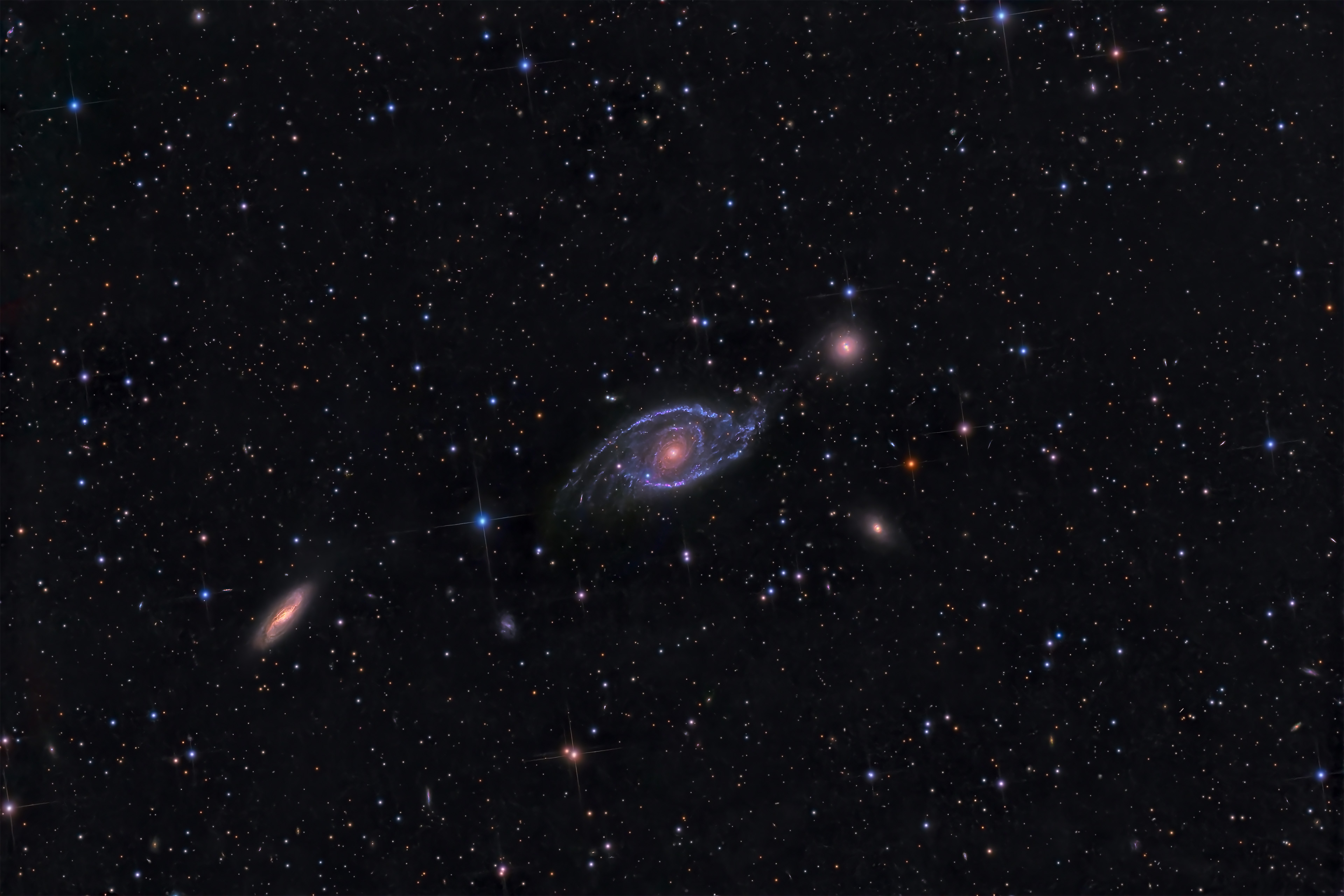
Annotations: In the image above and below, hover a mouse or
cursor over the image to reveal annotations identifying the
galaxies, stars and other interesting features. The first image
presents the complete original LRGB image with the foreground
stars visible. The annotated overlay identifies the position of NGC 1954, NGC
1957, IC 2132 and other objects in the field, together with
coordinate, deep-sky-object and stellar information. The fist
image below shows a different overlay indicating coordinates and
more object and star names.
Image #1 Above — The Full Field: The first image presents the complete deep LRGB field
with the foreground stars intact. What initially looks like a
single galaxy becomes, with careful inspection, a small
extragalactic neighborhood. NGC 1954 dominates the center, while
NGC 1957 appears above and to the right and the brighter,
elongated
IC
2132, also cataloged as PGC 17415, appears toward the lower
left. The extraordinary depth of this exposure is important. The
brilliant pinpoints scattered across the image are mostly
foreground stars in our own
Milky Way,
while the faint fuzzy objects are distant galaxies. The
photograph therefore contains several different astronomical
scales at once: nearby stars, a group of galaxies roughly 150
million light-years away, and still more distant background
galaxies far behind the group. The principal galaxy was
discovered by
William
Herschel on 14 December 1786. More than a century later, NGC
1957 was discovered by
Francis Leavenworth on 11 December 1885, and IC 2132 was
discovered by Herbert Alonzo Howe on 22 February 1898. The
modern photograph therefore connects three separate chapters of
deep-sky observing history.
A Galaxy That Refuses to Look Ordinary: NGC 1954 is classified as a spiral, but its
outer structure is strikingly unlike the clean, symmetrical arms
seen in many textbook spirals. The
Morphological Catalogue of Galaxies (MCG) is particularly
interesting here: its description of NGC 1954 notes two
extremely thin arcs that do not resemble ordinary spiral arms or
dense rings and identifies them as a collection of roughly 15–20
H II regions. An
H II region
is a cloud of ionized hydrogen, normally energized by
ultraviolet radiation from hot, young stars. In a deep color
image, such regions can stand out as blue-white or pinkish knots
because they contain newly formed massive stars and glowing
ionized gas. The arcs in NGC 1954 are therefore much more than
decorative details: they trace pockets of energetic star
formation arranged in a pattern that is unusual enough to make
the galaxy a particularly interesting target for
astrophotography.
The Annotated Field:
Hover over the image above to reveal the coordinate grid,
deep-sky-object identifications and stellar information. The
overlay makes it much easier to understand how crowded this
apparently quiet region of sky really is. The prominent
lower-left galaxy is
IC 2132,
also cataloged as PGC 17415. It is a smaller spiral galaxy,
roughly 144 million light-years away by one commonly used
redshift estimate. NGC 1957, by comparison, is a much smaller
lenticular/elliptical-type system and is only about 1.1 by 0.8
arcminutes in apparent size. Farther to the right is PGC 929166,
a much more distant background galaxy; catalog data place it at
roughly 349 million light-years. Its apparent proximity to NGC
1954 is therefore a striking example of two-dimensional
projection on the sky rather than evidence that the galaxies
belong to the same physical system. The image also contains
numerous extremely faint galaxies that do not immediately
announce themselves as galaxies. Their tiny, soft profiles are
especially important in the star-free version because removing
the foreground stellar points allows the low-surface-brightness
galaxy light to become easier to recognize.
The NGC 1954–NGC 1957 Connection: NGC 1957 lies approximately 5.1
arcminutes from NGC 1954. At the distance of NGC 1954, that
angular separation corresponds to roughly 69 kpc, or about
225,000 light-years in projection. That is an enormous
separation by everyday standards, yet it is close enough on
galactic scales that gravitational interaction is entirely
plausible. The deep image shows a particularly intriguing
bridge-like feature between the two systems. The faint material
appears to extend from the outer regions of NGC 1954 toward NGC
1957, creating one of the most fascinating features in the
entire photograph. If this is tidal material, it would represent
stars and other matter pulled away from their normal orbits by
gravitational interaction between the galaxies. A
tidal tail
or tidal bridge can form when the gravitational field of one
galaxy disturbs another. Such encounters can stretch a galaxy's
outer disk, distort spiral structure and redistribute gas and
stars. They can also compress gas and stimulate
star
formation. NGC 1954's peculiar arcs of H II regions make the
possibility especially intriguing. The photograph alone,
however, cannot establish that every faint strand between the
galaxies is physically connected material. Spectroscopic
observations and deep neutral-hydrogen observations would be
needed to determine the detailed physical relationship. What the
image does demonstrate remarkably well is that the space between
these galaxies is not simply empty blackness.
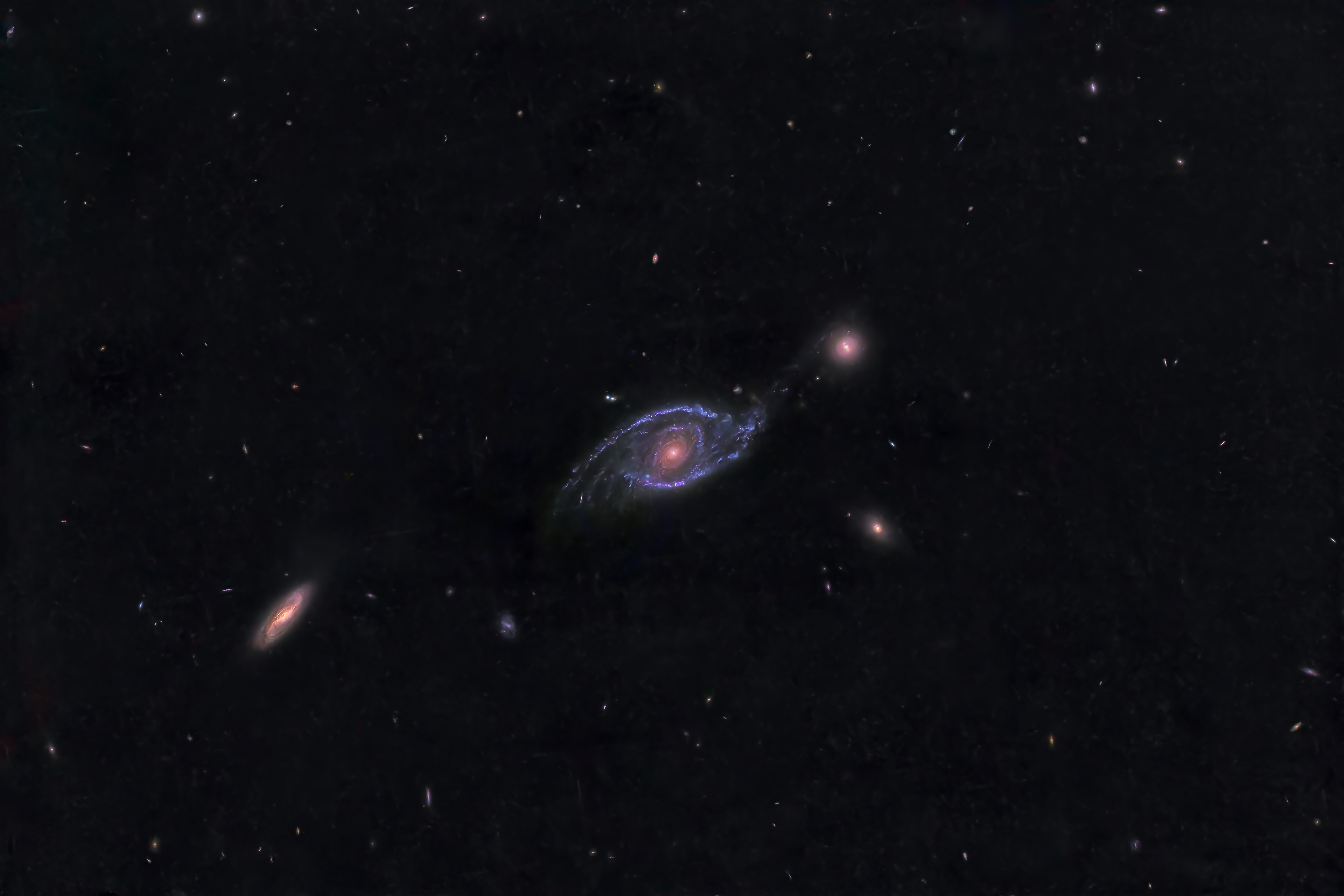
The Galaxy Field Without Stars: Hover over the image above
to restore the foreground stars. With the stars removed,
the image becomes a very different astronomical scene. Instead
of being dominated by hundreds of bright Milky Way points, the
eye is drawn toward the diffuse halos, faint companions and tiny
background galaxies. This is more than an aesthetic experiment.
Star removal is an effective way of separating two fundamentally
different populations in the image: relatively nearby Galactic
stars and distant extragalactic systems. The result makes the
enormous range of surface brightnesses in the field much easier
to appreciate. Some galaxies that are nearly invisible between
stars suddenly become obvious once the foreground clutter is
gone. The star-free view is particularly valuable around NGC
1954 because the galaxy's faint outer structure is precisely
where the most interesting clues reside. The thin arcs,
asymmetric extensions and extremely low-contrast material around
the disk are easily overwhelmed by the brighter foreground stars
in an ordinary view.
The Strange Outer Arcs: The
two thin arcs surrounding NGC 1954 are among the most unusual
features of the entire system. They do not have the clean,
sweeping geometry normally associated with major spiral arms.
Historical morphological notes describe them instead as thin
arcs containing numerous H II regions. This makes them look
almost like pieces of a second structure superimposed upon the
main disk. An
H II region
is created when intense ultraviolet radiation from young,
massive stars ionizes surrounding hydrogen gas. When the
electrons recombine with the hydrogen ions, characteristic
emission lines are produced, including the familiar red
H-alpha
line. These regions therefore provide a direct visual sign that
stars are forming or have formed relatively recently. The
unusual arrangement of H II regions in NGC 1954 is one of the
reasons the galaxy is so interesting. Rather than being
distributed only along conventional spiral arms, the regions
appear concentrated into remarkably thin curved structures.
Several possibilities can be considered, including an
interaction-related disturbance, an unusual ring-like structure,
or a disrupted portion of the galaxy's spiral pattern. The
morphology is genuinely unusual, although the image by itself
does not establish one definitive formation mechanism.
The Galaxy Core: At the center of NGC 1954 is a compact,
warm-colored nucleus surrounded by a much larger disk. The core
is significantly brighter and smoother than the outer regions,
reflecting the concentration of older stars toward the central
bulge and the strong surface-brightness gradient typical of
spiral galaxies. The nucleus is also the visual anchor for the
entire galaxy. From this bright central concentration, the disk
gradually expands outward into increasingly faint and complex
structure. In the deeper regions of the image, blue and violet
star-forming knots become visible along with subtle dust lanes
and irregular extensions. The contrast between the brilliant
core and the delicate outer structures makes NGC 1954 especially
attractive photographically. The galaxy contains both the
organized architecture expected of a spiral and the asymmetric
features that suggest a more complicated evolutionary history.
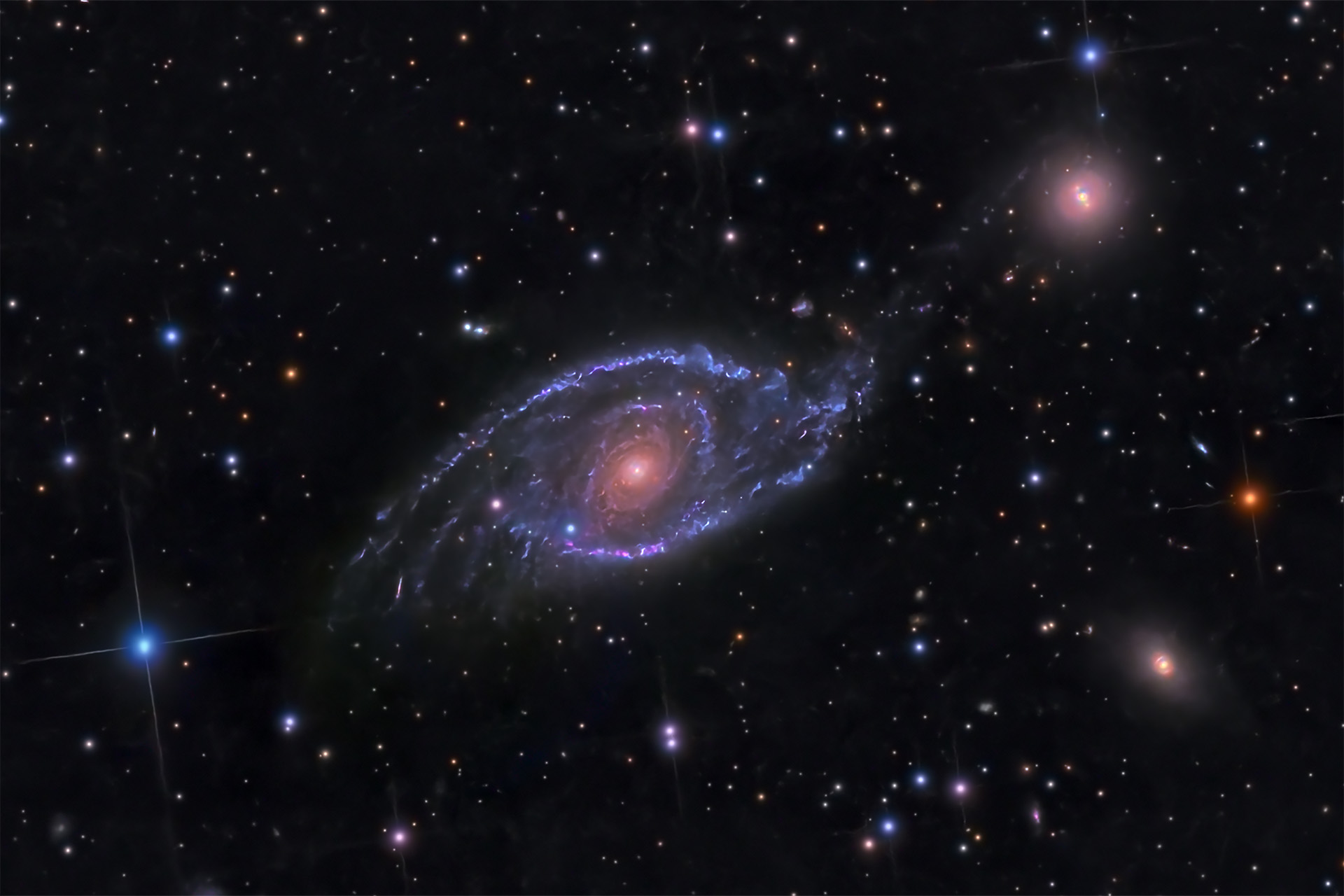
NGC 1954 and NGC 1957 Enlarged: The
enlarged view concentrates attention on the central pair. Here
the difference between the two galaxies becomes especially
dramatic. NGC 1954 is a large, luminous spiral with a richly
structured disk, while NGC 1957 is much smaller and far more
compact and smooth. NGC 1957 is commonly listed as an E3
elliptical in older catalogs, while modern classifications can
describe it as SB(rs:)0-. That difference illustrates an
important point about galaxy morphology: classification is not
always absolute, especially for faint systems whose low-contrast
structures are difficult to detect. A weak ring or disk can
change the classification even when the overall galaxy remains
visually dominated by a smooth stellar component. The faint
bridge between the galaxies is particularly interesting in this
enlarged view. If it is tidal debris, it represents stars and/or
other material that has been displaced from the galaxies by
their mutual gravitational interaction. Such bridges are among
the most visually direct signatures of galaxy encounters,
although the physical nature of this particular feature deserves
careful qualification rather than being treated as conclusively
proven from optical imaging alone.
NGC 1957 — The
Smaller Companion: NGC 1957 is dramatically smaller in
apparent size than NGC 1954. Its smooth, reddish appearance
indicates a stellar population quite different from the bright
blue star-forming regions visible in the larger spiral. Galaxies
dominated by older stars generally appear redder because their
light is produced primarily by long-lived, cooler stellar
populations rather than large numbers of hot, young blue stars.
The proximity of NGC 1957 to NGC 1954 makes the pair
particularly interesting. Their projected separation is only a
few hundred thousand light-years, comparable to the scale on
which galaxies can gravitationally influence one another. If the
faint bridge is physically associated with the pair, it may
preserve a record of a past gravitational encounter. The system
therefore offers a striking visual contrast: a large actively
structured spiral galaxy beside a much smaller and smoother
companion, with extremely faint material apparently extending
through the space between them.
Three Galaxies in a
Nearly Straight Line: The broader group becomes even more
interesting when IC 2132 is included. NGC 1957 lies roughly
southeast of NGC 1954, while IC 2132 lies northwest, producing a
striking nearly linear arrangement on the sky. The three
prominent galaxies therefore form an unusual visual composition
in the photograph.
IC 2132,
also cataloged as PGC 17415, is considerably more elongated than
NGC 1957 and presents a very different appearance from the
central galaxy. Its disk is tilted strongly with respect to our
line of sight, producing the narrow spindle-like shape visible
in the image. The three galaxies demonstrate how dramatically
galaxy morphology can vary even within a relatively small region
of sky. NGC 1954 displays a large disturbed spiral structure,
NGC 1957 is compact and comparatively smooth, and IC 2132
appears as an elongated disk galaxy.
IC 2132 — The
Other Prominent Galaxy: IC 2132 is particularly striking in
the wide-field photograph because its elongated disk is easy to
recognize even though it is much smaller than NGC 1954. It is
also cataloged as
PGC 17415. Its reddish-orange appearance contrasts with the
bluer regions visible within NGC 1954. Much of the color
difference in galaxies comes from the relative proportions of
young, hot stars and older stellar populations, as well as from
dust and the effects of image processing. Because IC 2132 lies
within the same general region of sky as NGC 1954 and NGC 1957,
it is tempting to assume that all three galaxies must be
gravitationally bound. Redshift and distance measurements,
however, are required to establish physical association. The
apparent alignment on the sky is compelling, but projection
effects are common in deep astronomical images.
PGC
929166 — A Much More Distant Galaxy: The small galaxy
identified as
PGC 929166 provides a wonderful demonstration of cosmic
perspective. It appears relatively close to NGC 1954 in the
two-dimensional photograph, yet catalog measurements place it at
a substantially greater distance. This is one of the great
illusions of deep-sky photography. Two galaxies can appear
separated by only a few arcminutes while actually being
separated by tens or hundreds of millions of light-years along
our line of sight. The photograph compresses a vast
three-dimensional universe onto a flat image. PGC 929166
therefore serves as an excellent reminder that apparent
proximity is not the same thing as physical proximity.
Supernovae in NGC 1954: The galaxy has also hosted an
unusually interesting sequence of stellar explosions. Three
supernovae have been reported in NGC 1954:
SN 2010ko,
SN 2011fi and
SN 2013ex. A
supernova
is one of the most energetic stellar explosions known. The
different types of supernova reveal different stellar processes.
Type
Ia supernovae are associated with thermonuclear explosions
involving white dwarfs, while
Type
II supernovae result from the core collapse of massive
stars. The presence of multiple supernovae in NGC 1954 is
another reminder that the galaxy is not a static island of
stars. It is an enormous, evolving system in which stars are
continually being born, aging and ending their lives in
spectacular events.
A Galaxy Seen Across Cosmic Time:
At roughly 150 million light-years, the light in this photograph
began its journey when Earth was still in a very different
chapter of geological history. The galaxy is therefore not being
seen as it exists today, but as it appeared roughly 150 million
years ago. Every star and galaxy in the photograph is similarly
a record of a different point along the line of sight. That
perspective becomes especially powerful when the foreground
stars are restored. The bright stars are members of our own
Milky Way, while NGC 1954 and its companions are roughly 150
million light-years away, and objects such as PGC 929166 can lie
more than twice as far away. A single photographic frame
therefore becomes a three-dimensional slice through the
universe.
The Foreground Stars: The numerous
bright stars scattered throughout the image are not members of
the NGC 1954 group. They are foreground stars belonging
primarily to our own
Milky Way
Galaxy. Their presence creates an extraordinary contrast of
scale. Some of the foreground stars are bright enough to produce
prominent diffraction spikes in the telescope image, while the
galaxies behind them appear as tiny, diffuse patches. Yet many
of those seemingly insignificant fuzzy objects contain billions
of stars. The star-free version of the image makes this
distinction particularly powerful. Removing the foreground stars
reveals what the field would look like if our own galaxy were
not placing so many stars directly along the line of sight.
Why This Field Is So Fascinating: NGC 1954 is not
famous because it is the brightest or largest galaxy in the sky.
It is fascinating because it combines several unusually
observable phenomena in one field: a large peculiar spiral, two
strange arcs packed with H II regions, a close companion galaxy,
a possible tidal bridge, a smaller neighboring spiral, multiple
faint background galaxies, and a history of supernova
explosions. The result is a superb example of why deep
astrophotography can reveal far more than visual observing
alone. What appears through a telescope eyepiece as a faint oval
glow can, after hours of exposure and careful processing, become
a complex map of stellar populations, star-forming regions,
tidal structure and galaxies separated by hundreds of millions
of light-years.
Image Processing - Then and Now: The
final comparison reveals perhaps the most dramatic change of
all: the same underlying astronomical scene can look profoundly
different when processed with newer techniques. The comparison
uses the older generation of processing as a reference and fades
to the newer processing while keeping the image aligned. This is
particularly revealing for NGC 1954 because the scientifically
interesting structures are extremely faint. Improved background
modeling, noise control, color separation, star treatment and
nonlinear image-stretching techniques can make
low-surface-brightness features much easier to see without
changing the underlying photons that were recorded. The
difference is therefore not a change in the galaxy. It is a
change in how much of the recorded information can be extracted
and displayed. The faint bridge toward NGC 1957, the outer H
II-region arcs, subtle galaxy halos and tiny background systems
become much more apparent when the processing is able to
preserve low-contrast structure without overwhelming it with
noise or artificial gradients. Your original NGC 1954 image was
acquired in January 2014 with a 20-inch RC Optical Systems
telescope at f/8.2, an SBIG STXL-11002 camera and adaptive
optics, using LRGB exposures of 380:50:50:50 minutes. The new
presentation demonstrates how much additional information can
sometimes be recovered from mature archival data simply by
applying substantially improved processing methods.
Historical Perspective: NGC 1954 was discovered by
William
Herschel on 14 December 1786 during his systematic surveys
of the night sky. Herschel's observations helped establish the
foundation for many of the deep-sky catalogs used by astronomers
today. NGC 1957 was discovered nearly a century later by
Francis Leavenworth on 11 December 1885. IC 2132 was
subsequently discovered by Herbert Alonzo Howe on 22 February
1898. The modern image therefore brings together objects first
recorded by astronomers working with very different generations
of telescopes. Herschel could see NGC 1954 as a faint nebulous
object, while modern CCD imaging can reveal extremely faint
outer structures and possible tidal material that would have
been completely beyond the sensitivity of eighteenth-century
observations.
A Cosmic Laboratory: NGC 1954
provides an opportunity to study many of the fundamental
processes that shape galaxies. Its
morphology records the distribution of stars, gas and dust.
Its H II regions reveal recent star formation. Its peculiar
outer arcs may preserve evidence of unusual dynamical processes.
Its proximity to NGC 1957 provides an opportunity to investigate
possible gravitational interaction. The system is therefore much
more than an attractive astrophotographic target. It is an
example of how galaxies evolve under the competing influences of
gravity, star formation, gas dynamics and interactions with
neighboring systems.
One Photograph — An Entire
Universe of Stories: When viewed casually, NGC 1954 may
appear to be little more than a faint spiral surrounded by
stars. But look more closely and the photograph becomes a map of
cosmic history. The bright central core represents an enormous
concentration of stars. The delicate outer disk records the
distribution of stars, gas and dust. The blue and violet H II
regions reveal young stellar populations. The faint bridge
toward NGC 1957 may record a gravitational encounter. The tiny
background galaxies extend the scene far beyond the immediate
group. Even the foreground stars contribute to the story. They
are relatively nearby objects in our own Milky Way, while the
galaxies behind them are hundreds of millions of light-years
farther away. The photograph therefore spans an extraordinary
range of distance and scale.
The Great Perspective:
The most beautiful aspect of this image may be the contrast
between its apparent simplicity and its actual complexity. The
field looks like a quiet patch of sky, yet it contains nearby
stars, a large spiral galaxy, a smaller companion, another
neighboring galaxy, possible tidal material, glowing hydrogen
regions, supernova remnants of stellar history and galaxies far
beyond the immediate group. The image also demonstrates the
extraordinary power of long-exposure astrophotography.
Structures that are almost invisible in a short exposure can
become prominent after many hours of accumulated photons and
careful processing.
Final Perspective: NGC 1954
is a beautiful example of a galaxy caught between order and
disturbance. Its central bulge and broad spiral disk show the
architecture of a mature spiral galaxy, yet its peculiar outer
arcs, concentrations of H II regions and faint material toward
NGC 1957 hint at a much more complicated history. The most
captivating feature may be the faint bridge-like structure
connecting the central galaxy with NGC 1957. Whether every
strand visible in this image is physically part of a tidal
bridge cannot be established from the photograph alone, but the
feature provides a powerful visual invitation to investigate the
system as an interacting galaxy pair. More than two centuries
after William Herschel first recorded NGC 1954, modern digital
imaging can reveal structures that were completely beyond the
reach of the telescopes of the eighteenth and nineteenth
centuries. The result is not merely a better-looking picture. It
is a deeper view into the physical history of a galaxy — a
history written in star formation, disturbed orbits, glowing
hydrogen, faint tidal structure and the slow gravitational
choreography of galaxies.
Object Statistics:
Principal Object: NGC 1954 (PGC 17422 / MCG -02-15-003),
Constellation: Lepus,
Epoch: J2000,
Right
Ascension: 05h 32m 48.34s,
Declination: -14° 03'
45.6",
Morphology: SA(rs)bc pec?,
Visual Magnitude:
approximately 11.8,
B Magnitude: approximately 12.4,
Angular Size: approximately 4.2' × 2.0',
Position Angle:
approximately 150°,
Redshift: z = 0.010437,
Heliocentric Radial Velocity: approximately 3,129 km/s,
Distance: approximately 46.8 Mpc / 153 million light-years,
Estimated Major Physical Size: approximately 59 kpc /
192,000 light-years,
Projected Minor Size: approximately
27 kpc / 89,000 light-years,
Companion: NGC 1957,
approximately 5.1' away,
Other Prominent Galaxy: IC 2132
(PGC 17415), approximately 9.3' northwest,
Group/Association:
LDCE 398; also discussed as the HDCE 0361 trio,
Known
Supernovae: SN 2010ko, SN 2011fi and SN 2013ex,
Discovery: William Herschel, 14 December 1786. The quoted
physical diameter depends on which catalog angular diameter and
distance are adopted. Using 4.2 arcminutes and 46.79 Mpc gives
about 57 kpc, or 187,000 light-years, while some catalog
estimates round the galaxy to roughly 59 kpc (192,000
light-years). Older distance estimates produce smaller values.
The important point is that NGC 1954 is a very large spiral
galaxy, roughly comparable to or larger than the commonly quoted
diameter of the Milky Way.