NGC 474 ~ A Lenticular Galaxy Stuck In A Loop!
| Optics: |
Ritchey–Chrétien 20" F/8.2 (4166mm FL) |
Processing: |
PixInsight, Photoshop |
| Camera: |
SBIG STXL-11000 with Adaptive Optics |
Date: |
October 2026 |
|
11 Megapixel (4008 x 2672 16-bit sensor) |
Location: |
Columbus, Texas |
| Exposure: |
LRGB = 650:160:80:100 minutes |
Imager: |
Kent E. Biggs |
A Cosmic Mystery Hidden in Plain Sight. At first
glance,
NGC 474
appears to be a rather ordinary
lenticular galaxy, an intermediate type of galaxy with a
bright central bulge and a relatively smooth disk, sharing
characteristics of both spiral and elliptical galaxies. But look
a little deeper, and this seemingly peaceful island universe
reveals a spectacular secret! Surrounding its luminous core are
enormous, faint arcs, ripples, loops, and shells of stars that
seem to swirl around the galaxy like ghostly streams of cosmic
smoke. These structures are the scars of a violent past,
possibly recording the gravitational destruction of another
galaxy and the continuing interaction with its neighbor,
NGC 470.
Located approximately 100 million
light-years
from Earth in the constellation
Pisces, NGC 474 is so large that its visible and extended
stellar structures span hundreds of thousands of light-years.
The galaxy is also cataloged as
Arp 227 in
astronomer
Halton Arp's famous
Atlas of Peculiar Galaxies, where it is recognized for its
unusual concentric-ring appearance. What looks like a collection
of delicate celestial ornaments may actually be the debris of a
galactic catastrophe unfolding over billions of years.
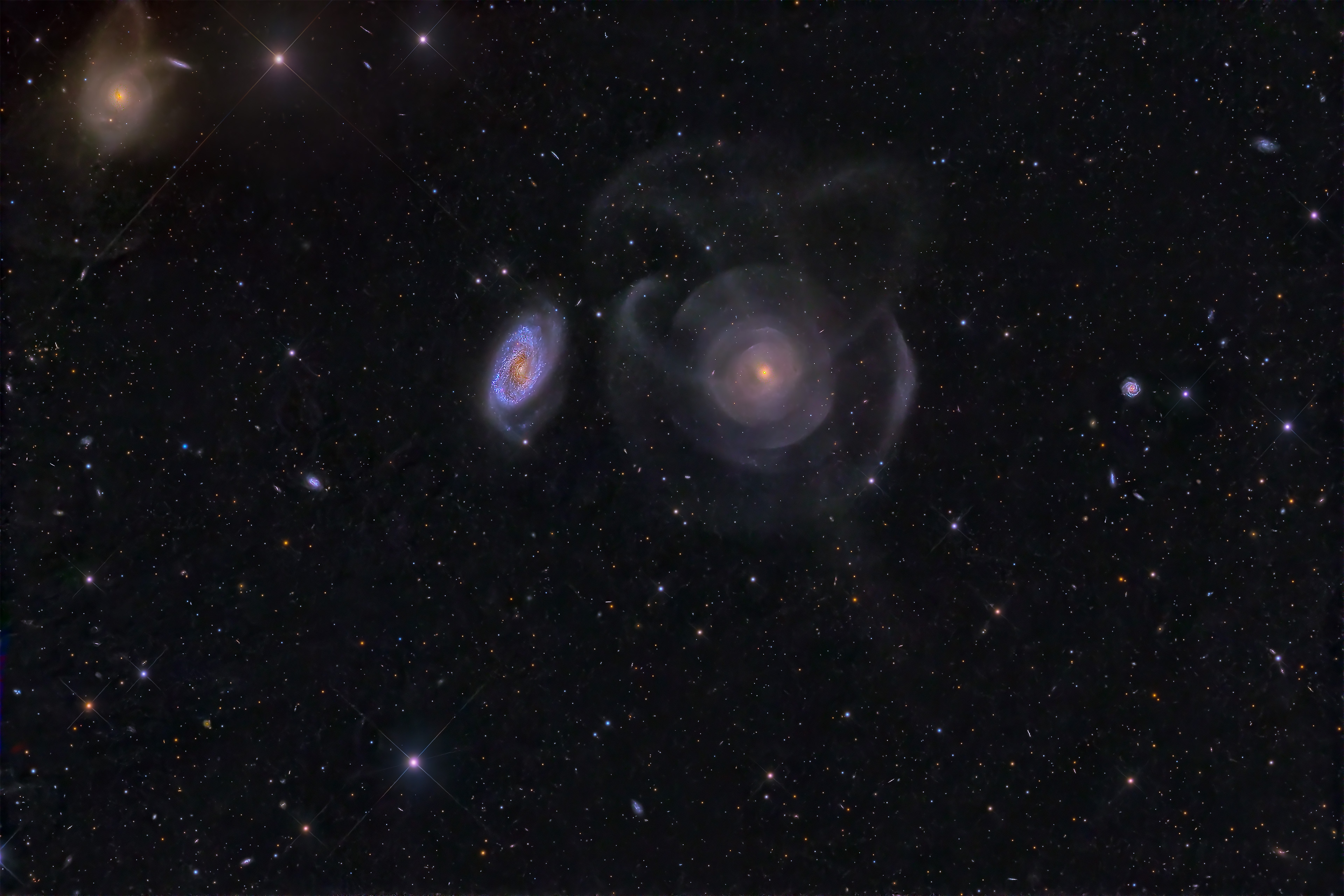
A Galaxy Surrounded by Cosmic Ghosts The image above presents the full color view
of NGC 474 and NGC 470, complete with foreground stars. Spend a
moment exploring the image with your mouse. Hovering over Image
#1 reveals numerous insets highlighting faint galaxies, subtle
outer structures, and other fascinating details that might
otherwise escape notice. These insets are an invitation to
explore the image as an astronomical detective rather than
simply admire it as a pretty picture. The most remarkable
feature is the faint, sprawling material surrounding NGC 474.
The brighter central region is only the beginning of the story.
Far beyond the obvious body of the galaxy, delicate arcs and
loops extend into the darkness. Some resemble concentric ripples
spreading across a pond after a stone strikes the water; others
appear like wispy tendrils stretched and twisted by invisible
forces. These are examples of what astronomers call
stellar
shells and
tidal debris.
The extraordinary challenge is that these structures have an
extremely low
surface brightness. Their light is spread over enormous
areas, making them much harder to record than the bright central
regions of galaxies. Long exposures and careful image processing
can reveal features that are almost invisible in shorter
exposures. Your deep image provides a wonderful opportunity to
appreciate how much of a galaxy's history lies beyond its
apparently smooth central body.
Why Does NGC 474 Have So Many Stellar Loops?
One leading explanation is
that NGC 474 experienced a major or intermediate merger with a
smaller galaxy roughly two billion years ago. As the smaller
galaxy plunged into the gravitational field of its larger
companion, its stars were pulled away from their original orbits
and scattered through space. Rather than disappearing
immediately, these stars continued moving under the influence of
gravity, forming enormous arcs, shells, and streams around the
surviving galaxy. This process is closely related to
galactic
tidal forces. When a galaxy passes close to another,
different parts of it experience different gravitational
accelerations. The resulting forces can stretch the galaxy,
strip away stars and gas, and rearrange its structure. Over
time, stars released from a disrupted companion can pile up
along particular orbital paths, producing the distinctive
shell-like patterns visible around NGC 474. Some of these
shells may be
phase-wrapped stellar structures: stars released at
different times travel along similar paths but arrive at
different orbital phases, creating sharp arcs and nested layers.
Other features may be extended tidal streams or plumes. The
precise origin of every loop remains an active research
question, and it is possible that more than one interaction
contributed to the remarkable structure we see today. For
further reading, see the scientific study
NGC 474 as viewed with KCWI: diagnosing a shell galaxy,
which used spectroscopy to examine both the galaxy's center and
an outer shell. The researchers found evidence that the shell
contains a substantial population of younger stars, consistent
with material brought in from elsewhere rather than formed
entirely within the original galaxy.
NGC 470 - The Neighbor That May Be Feeding the Giant.
Now turn your attention to NGC 470, the prominent spiral galaxy close to NGC
474. Unlike the smoother appearance of its companion, NGC 470
displays the characteristics of a disk galaxy with spiral
structure and active star formation. The two galaxies are
separated by only about 5.4 arcminutes on the sky, corresponding
to a projected distance of roughly 47,000 light-years at their
commonly adopted distance. That is a surprisingly small
separation on a cosmic scale for two galaxies of this size.
The apparent closeness is more than a coincidence. Research
on the
Arp 227
galaxy group has identified neutral hydrogen gas extending
from NGC 470 toward NGC 474. Such gas structures are evidence of
gravitational interaction and may represent material being
stripped from one galaxy and transferred toward another. Studies
have suggested that NGC 474 is accreting gas from its spiral
neighbor, while NGC 470 itself has been observed to have an
active central star-forming region. Imagine two immense
stellar systems moving through space, each containing billions
of stars. Their stars are separated by vast distances, so direct
stellar collisions are exceedingly unlikely. Yet their combined
gravitational fields can reshape their disks, disturb their gas,
strip away material, and trigger new episodes of star formation.
Galaxies can therefore collide without most of their stars ever
physically touching one another. Could NGC 470 be responsible
for all of NGC 474's loops? Not necessarily.
Astronomers continue to investigate whether the shell system
primarily records a merger with a smaller, now-disrupted galaxy,
a gravitational encounter involving NGC 470, or a more
complicated sequence of events. The evidence for gas transfer
between the two galaxies is particularly intriguing, but it does
not by itself prove that NGC 470 created every visible shell.
NGC 474 Annotated Field!
The Annotated Field: Identifying the Cosmic Cast
Image #2 above presents the original image with
annotations generated using
PixInsight. Hover your mouse over the image to reveal the
annotations identifying celestial coordinates, foreground stars,
and deep-sky objects. This view transforms the image into a
guide to the many objects occupying this small patch of sky.
One of the most important distinctions in astronomical
imaging is the difference between stars in our own
Milky Way
Galaxy and distant galaxies far beyond it. The bright stars
scattered across the field are foreground objects within our own
galaxy. Their prominent diffraction spikes are produced by the
telescope's optical system and the interaction of light with its
structural elements; the spikes are not physical beams extending
across interstellar space. By contrast, the tiny fuzzy
objects scattered throughout the background may be distant
galaxies, each containing millions or billions of stars. Some
may lie far behind the NGC 474 group, at distances many times
greater than the roughly 100 million light-years separating us
from NGC 474. Their apparent size alone cannot reliably
establish their distance: a small-looking galaxy might be
intrinsically small, very distant, or both. The
annotations are particularly useful for distinguishing cataloged
objects from faint structures that are part of NGC 474 itself. A
galaxy designation can be checked against astronomical databases
such as
SIMBAD
and the
NASA/IPAC
Extragalactic Database (NED). These resources provide
coordinates, classifications, measured redshifts, and references
to published research.
A Galaxy's Core: The Calm Center of a Turbulent Past. At the heart of NGC 474
lies a bright concentration of stars, the central bulge and
inner body of this lenticular galaxy. Compared with its
spectacular outer loops, the core appears relatively smooth and
orderly. Yet its present appearance does not mean that its
history has been peaceful. Galactic mergers can
redistribute stars, alter stellar orbits, and change the balance
between ordered rotation and random motion. Spectroscopic
studies of NGC 474 have found interesting differences between
the stellar populations in its central region and those in its
outer shell. The core is dominated by intermediate-aged stars,
while the examined shell region contains a substantial
population of younger stars. These differences provide clues
about the galaxy's assembly history and the origin of its outer
structures. A bright central core should not
automatically be interpreted as evidence of an actively feeding
supermassive black hole. A galaxy can possess a dense stellar
nucleus without displaying the unmistakable signatures of an
active galactic nucleus. Establishing whether the core is
currently active requires additional evidence, such as suitable
spectroscopy, radio observations, or high-energy measurements.
What About the Faint Stellar Jet? The
subtle, elongated features visible in a deep image invite a
closer look. A faint linear feature can sometimes resemble a
jet, but appearances alone are not sufficient to establish that
it is one. In astronomical terminology, a true relativistic jet
is a narrow outflow of energetic particles launched from the
environment of a compact object, often a supermassive black
hole. Such jets can extend far beyond a galaxy's central region
and may be prominent at radio wavelengths. For NGC 474,
the best-established large-scale structures are its stellar
shells, loops, streams, and tidal debris. I would not identify a
faint feature in this particular image as a confirmed
astrophysical jet without independent observational evidence. If
an apparent narrow extension can be matched to a cataloged
source or verified with radio, X-ray, or other observations, it
may be possible to establish its nature. Otherwise, it is more
scientifically accurate to describe it as a candidate faint
extension or linear feature rather than a confirmed jet.
NGC 474 Without Stars!
Removing the Stars: Revealing the Galaxies Beneath.
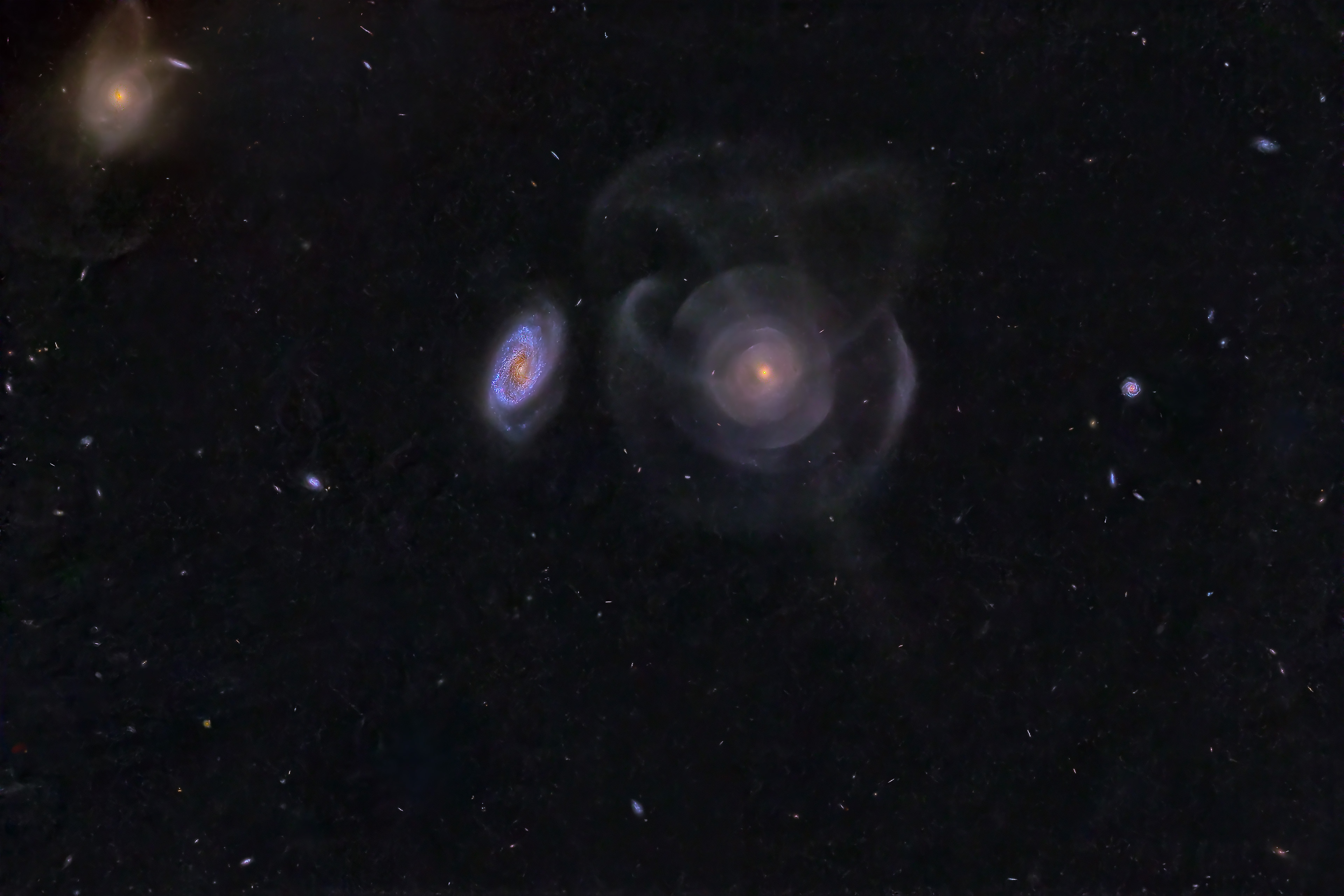
Image #3, above, shows the same original image with
the foreground stars removed. Move your mouse over the image to
bring the stars back and compare the two views. This simple
visual comparison demonstrates just how much foreground stars
can compete with the faint structures astronomers are trying to
study. With the stars removed, the extended glow around
NGC 474 becomes easier to follow. The eye can concentrate on the
galaxy's outer envelope and the subtle features that would
otherwise be obscured by bright stellar images and diffraction
spikes. The resulting view is particularly useful for studying
low-surface-brightness material, including shells and diffuse
tidal debris. Star removal is a processing technique, not
a discovery of new physical structures. The original image
remains the observational record, while the star-reduced version
is a complementary presentation designed to make certain details
easier to examine. As with all image processing, subtle
structures should be checked against the original data to
distinguish genuine astronomical features from processing
artifacts.
Stellar Streams, Galactic Halos, and the
Hierarchical Universe. NGC 474 illustrates a
fundamental idea in modern cosmology: galaxies grow and evolve
through the gradual assembly of smaller systems. This process is
often described as
hierarchical galaxy formation. Instead of every large galaxy
forming in one event and remaining unchanged, galaxies can grow
over billions of years by accreting smaller galaxies, acquiring
gas, and responding to gravitational encounters. The
outer halos of galaxies are therefore not necessarily smooth,
featureless regions. They may contain faint stellar streams,
shells, globular clusters, and remnants of ancient companions.
Our own Milky Way provides examples of this process, including
stellar streams associated with disrupted satellite galaxies.
The structures surrounding NGC 474 offer a particularly dramatic
view of similar processes occurring in another galaxy system.
Because these features are so faint, their study requires
more than simply identifying the brightest parts of a galaxy.
Astronomers use deep imaging, precise background subtraction,
stellar-population measurements, and spectroscopy to determine
how the stars move and when they formed. By studying the light
from the shells, researchers can begin to reconstruct the
sequence of events that shaped the galaxy.
NGC 474 Zoomed In!
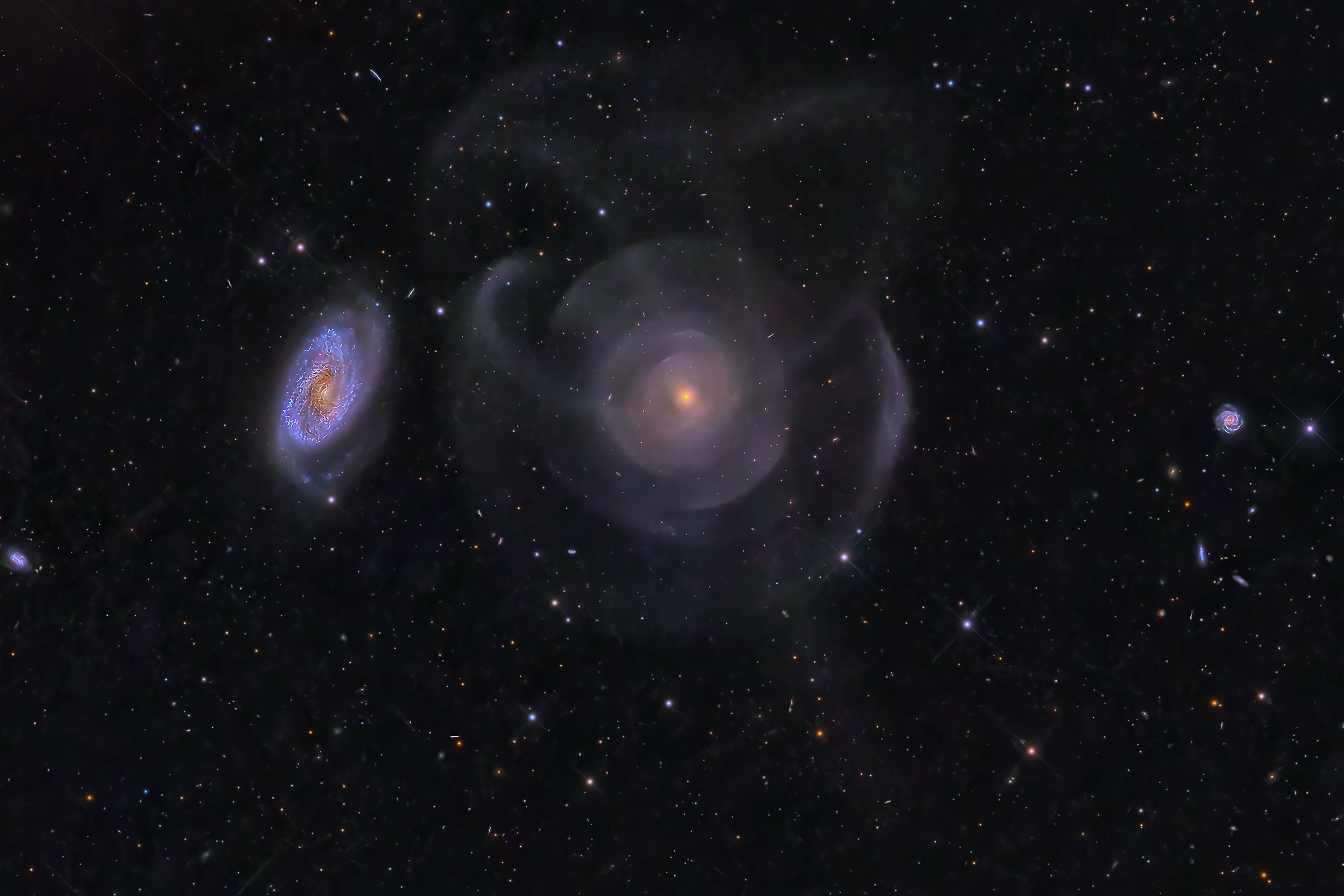
Zooming In: NGC 474 and NGC 470 Up Close! Image #4, above,
provides a closer view of the two principal galaxies. NGC 474's
rounded central body contrasts with the disk and spiral
structure of NGC 470. The difference is a reminder that galaxies
can have very different appearances even when they occupy the
same neighborhood and may be interacting gravitationally.
Look beyond the brightest regions. NGC 474's shell system is
not merely a decorative halo; it is an enormous record of
stellar motion. Each arc may contain stars whose orbits were
altered during an encounter or merger. Their distribution
provides a fossil record of the galaxy's past, much as
geological layers preserve evidence of ancient events on Earth.
NGC 470 offers a complementary story. Its spiral disk and
gas-rich environment make it an important object for
understanding how interactions affect star formation and the
transfer of material between galaxies. The two galaxies are
close in projected position and have similar recession
velocities, supporting their association, although a projected
separation is not itself a direct measurement of their
three-dimensional distance. The pair is a reminder that a
photograph of a galaxy is not simply a portrait of an isolated
object. It is a snapshot of a dynamic system shaped by gravity,
stellar evolution, gas flows, and encounters that can unfold
over hundreds of millions or billions of years.
Historical Discovery and the Arp 227 Classification
NGC 474 and NGC 470 were discovered by
William
Herschel on December 13, 1784, during his systematic
exploration of the night sky with his reflecting telescope. At
the time, these faint objects were recorded as nebulae because
their true nature as distant stellar systems was not yet
understood. More than a century later, the development of
photographic astronomy and modern extragalactic research
revealed that galaxies could possess intricate structures
extending far beyond their bright central regions. In 1966,
astronomer
Halton Arp included NGC 474 in his
Atlas of Peculiar Galaxies, cataloging it as Arp 227 in the
category of galaxies with concentric rings. The
historical record is a wonderful illustration of how astronomy
progresses. What once appeared to be a relatively unremarkable
nebula became a key example of the complex structures produced
by galaxy interactions. Later deep imaging, including
observations with modern wide-field cameras, revealed the
extraordinary extent of its shells and streams.
Further Reading and Scientific References. For an
extraordinary comparison with other deep observations of this
system, see NASA's
Galaxy NGC 474: Shells and Star Streams. The
2011
Astronomy Picture of the Day feature on shell galaxies in Pisces
discusses the possible gravitational origins of the Arp 227
system. Another useful presentation is the
2018 NASA
Astronomy Picture of the Day image of NGC 474. For
the scientific investigation of the shells and stellar
populations, see
NGC 474 as viewed with KCWI: diagnosing a shell galaxy. For
the earlier observational study of shell structures and their
possible relationship to galaxy interactions, see
Imaging of the shell galaxies NGC 474 and 7600, and implications
for their formation. Additional object data can be found through
SIMBAD's NGC 474 entry,
SIMBAD's NGC 470 entry, and the
NASA/IPAC Extragalactic
Database.
NGC 474 and NGC 470 — Astronomical Statistics.
The following values are representative
published measurements. Distances and physical sizes are
estimates, and apparent dimensions can vary between catalogs
depending on the wavelength and surface-brightness threshold
used.
NGC 474 — The Shell GalaxyCatalog
designation: NGC 474; Arp 227; UGC 864; PGC 4801
Object type:
Lenticular galaxy (S0), shell galaxy
Constellation:
PiscesRight Ascension (J2000): 01h 20m 06.7s
Declination (J2000): +03° 24′ 56″ (approximately)
Apparent
visual magnitude: approximately 11.5–12.4, depending on catalog
and measurement
Angular size: approximately 7.1 × 6.3
arcminutes in commonly cited catalogs
Distance from Earth:
approximately 95–100 million light-years
Estimated physical
diameter: up to approximately 250,000 light-years when the
extended stellar envelope is included
Recession velocity:
approximately 2,300–2,400 km/s, depending on the reference frame
and measurement
Notable features: Concentric stellar shells,
tidal loops, stellar streams, and extended
low-surface-brightness debris
Historical discovery: William
Herschel, December 13, 1784
Additional reference:
NGC 474 catalog
and background information
NGC 470 — The Spiral CompanionCatalog designation: NGC 470; UGC 858; PGC 4777
Object type: Spiral galaxy
Constellation:
PiscesRight Ascension (J2000): 01h 19m 44.85s
Declination (J2000): +03° 24′ 36″ (approximately)
Apparent
visual magnitude: approximately 11.8
Angular size:
approximately 2.4–2.9 × 1.3–1.7 arcminutes, depending on catalog
Distance from Earth: approximately 100–110 million light-years,
with estimates varying by method
Estimated physical diameter:
roughly 70,000–90,000 light-years, depending on the adopted
distance and angular measurement
Recession velocity:
approximately 2,585 km/s (heliocentric)
Notable features:
Spiral disk, central star-forming activity, and evidence of
possible gas transfer associated with interaction in the Arp 227
system
Historical discovery: William Herschel, December 13,
1784
Additional reference:
NGC 470 catalog
and background information
A Final Perspective — The Universe Writes Its History in Starlight. NGC 474
is far more than a smooth lenticular galaxy with an unusual
appearance. Its immense loops and shells reveal a galaxy whose
history has been written in the gravitational disruption of
stars and the gradual assembly of stellar systems. Nearby NGC
470 adds another layer to the story, with its spiral disk and
possible exchange of gas suggesting that the evolution of this
galactic neighborhood may not be finished. When you look
at these images, you are seeing light that began its journey
roughly 100 million years ago, long before humans existed. The
delicate outer arcs may preserve the remnants of events that
happened billions of years in the past, while the two galaxies
continue their slow gravitational dance. Each faint feature is a
clue, each annotated object a new discovery, and each deeper
exposure an opportunity to uncover another part of the story.
In the grand theater of the cosmos, NGC 474 is a spectacular
reminder that galaxies are not static islands. They are living
records of cosmic evolution, shaped by gravity, transformed by
encounters, and surrounded by the ghostly remains of their past.