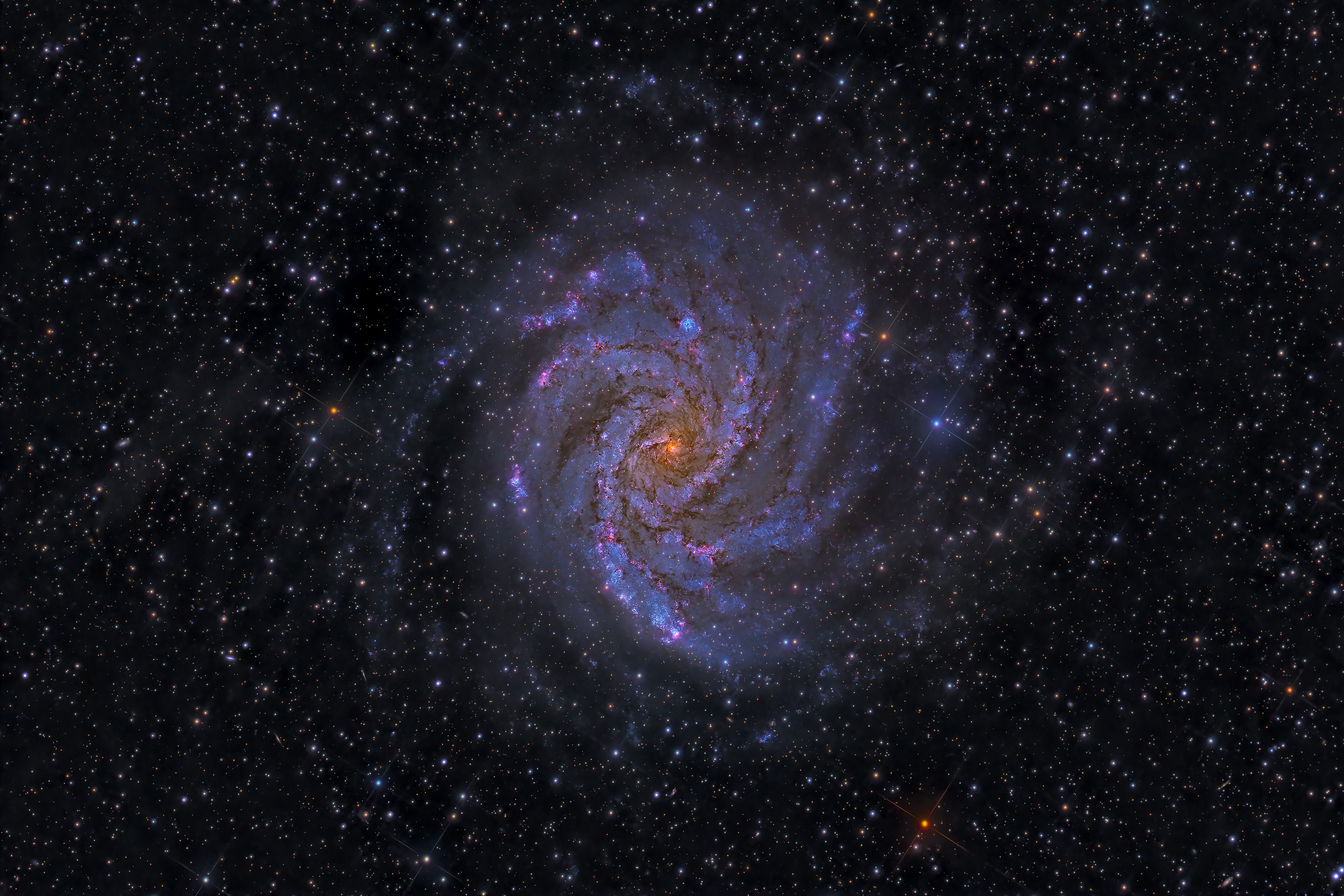
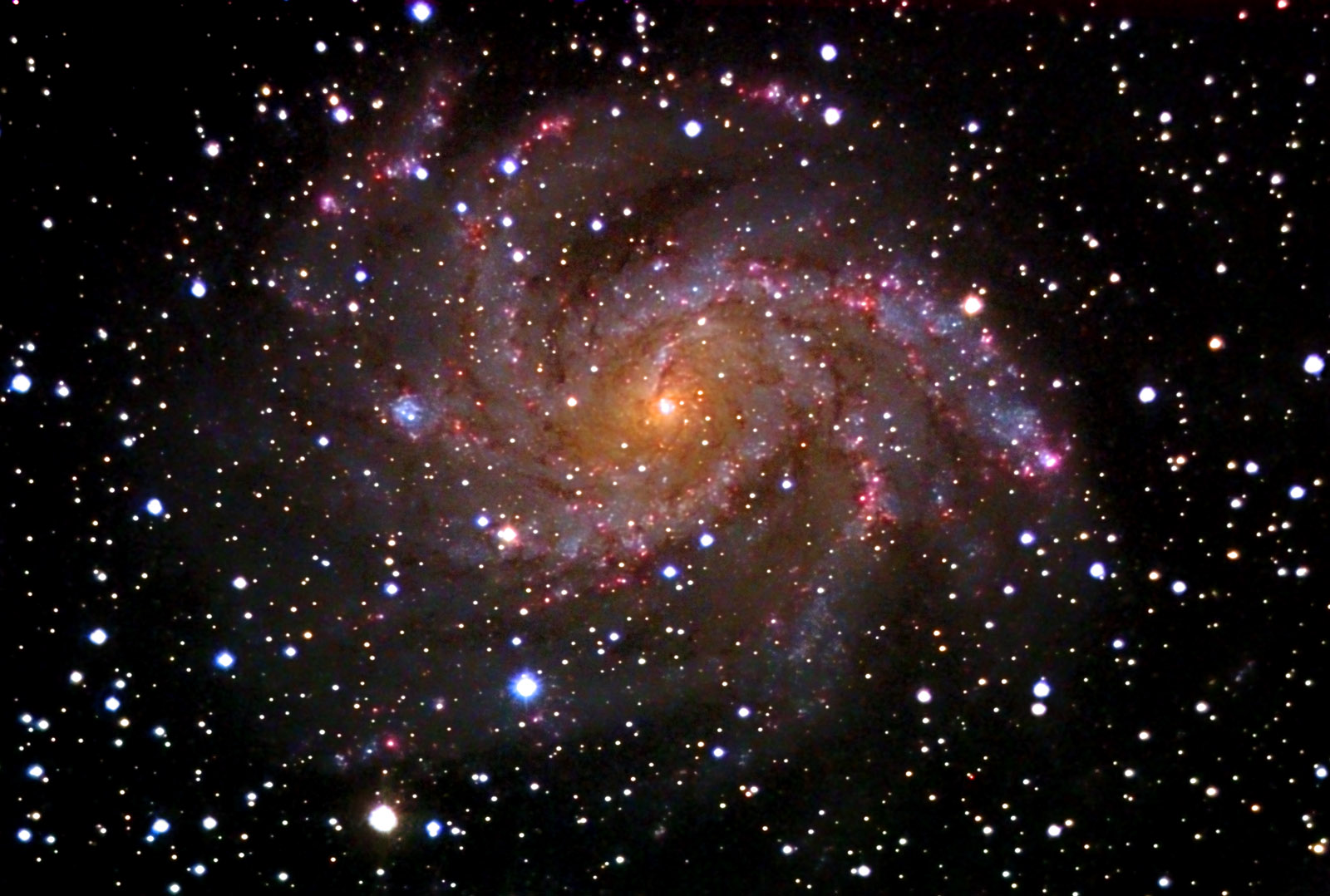
Details: NGC 6946 was discovered by the English astronomer
William
Herschel on September 9, 1798. The galaxy shines at an
apparent
magnitude of approximately 9.6 and spans nearly 11 × 10
arcminutes
across the sky. Although only about two-thirds the diameter of
the
Milky Way,
measuring roughly 115,000 light-years across, it contains an
extraordinary abundance of gas and dust that fuels vigorous
star
formation. Because the galaxy lies close to the plane of our
own Milky Way, foreground stars and interstellar dust partially
veil the view, adding depth and complexity to deep astronomical
images.
The Spiral Arms: NGC 6946 is classified
as an intermediate spiral galaxy with multiple fragmented spiral
arms rich in young stellar populations. Brilliant blue
associations of massive hot stars outline the spiral structure,
while intricate dark dust lanes weave inward toward the bright
yellow-orange nucleus. Numerous glowing pink
H II regions
trace the locations where ultraviolet radiation from newly
formed stars ionizes surrounding hydrogen gas. Unlike many
grand-design spirals with only two dominant arms, the Fireworks
Galaxy displays a more flocculent appearance, with countless
branching segments filled with active stellar nurseries.
The Red Ellipse: One of the most remarkable features
within NGC 6946 is the famous
Red Ellipse, a rare
elliptical emission nebula located in one of the northern spiral
arms. Measuring nearly 1,000 light-years across, this unusual
object was initially suspected to be the remnant of an
exceptionally energetic supernova explosion. More recent studies
indicate that it is likely an enormous
superbubble
formed by the combined stellar winds and supernova explosions of
a cluster of massive young stars. Its striking elliptical shape,
bright hydrogen emission, and surrounding arcs make it unlike
almost any other known nebula in nearby galaxies. The Red
Ellipse has become one of the most recognizable and
scientifically intriguing structures within NGC 6946, attracting
continued study as astronomers seek to understand the powerful
processes responsible for shaping such immense cavities within
the interstellar medium.
Hodge's Complex:
Another extraordinary feature is
Hodge's Complex, one of
the largest known star-forming complexes in any nearby spiral
galaxy. Discovered by astronomer
Paul Hodge, this immense region contains numerous young star
clusters, glowing hydrogen clouds, and one of the galaxy's most
massive super star clusters. Extending over several thousand
light-years, Hodge's Complex represents an enormous stellar
nursery where intense episodes of star formation continue to
shape the surrounding gas and dust. Some astronomers have
proposed that this remarkable complex may have been triggered by
the impact of a high-velocity gas cloud or even the remains of a
disrupted dwarf galaxy, although its exact origin remains an
active area of research.
The Fireworks Galaxy:
NGC 6946 has produced ten observed supernovae since 1917, more
than almost any other galaxy visible from Earth. These include
SN 1917A, SN 1939C, SN 1948B, SN 1968D, SN 1969P, SN 1980K, SN
2002hh, SN 2004et, SN 2008S, and SN 2017eaw. This exceptional
supernova rate reflects the galaxy's unusually vigorous star
formation, where massive short-lived stars continually reach the
ends of their lives in spectacular explosions. These events
enrich the surrounding interstellar medium with heavy elements
while generating shock waves that compress nearby gas clouds,
helping trigger the birth of future generations of stars.
The Galactic Ecosystem: Radio observations reveal
that NGC 6946 contains more than one hundred enormous cavities
within its hydrogen gas disk known as
H I
holes. Many of these giant structures span thousands of
light-years and are believed to have formed through the combined
effects of stellar winds and multiple supernova explosions.
Together with giant molecular clouds, expanding superbubbles,
magnetic fields, and widespread star-forming regions, these
features create a remarkably dynamic environment where stellar
evolution continuously reshapes the galaxy's appearance.
A Nearby Laboratory: Because of its relatively close
distance and nearly face-on orientation, the Fireworks Galaxy
has become one of astronomy's premier laboratories for studying
spiral structure and star formation. Observations across the
electromagnetic spectrum—from radio and infrared through visible
light, ultraviolet, and X-rays—allow astronomers to investigate
every stage of stellar evolution within a single galaxy. Giant
molecular clouds reveal where stars will soon form, brilliant H
II regions mark newly born stellar populations, while supernova
remnants and expanding bubbles illustrate how massive stars
ultimately return material back into the galactic environment.
A Window into Stellar Evolution: The Fireworks
Galaxy beautifully demonstrates the continuous cycle of creation
and destruction that governs spiral galaxies. Cold clouds of gas
collapse under
gravity to form new stars, whose intense radiation and
stellar winds sculpt the surrounding nebulae. Massive stars then
end their lives as brilliant supernovae, enriching the galaxy
with heavy elements essential for future stars, planets, and
ultimately life itself. NGC 6946 provides astronomers with one
of the clearest nearby examples of this ongoing cosmic recycling
process, making it one of the most scientifically valuable
galaxies in the northern sky.
Annotations: In the annotated image above, hover your mouse or cursor over the
image to reveal labels identifying the bright central nucleus,
prominent spiral arms, numerous giant H II star-forming regions,
the remarkable
Red Ellipse, the enormous stellar nursery
known as
Hodge's Complex, and the locations bright white
and red stars. These annotations highlight
many of the galaxy's most scientifically significant structures.
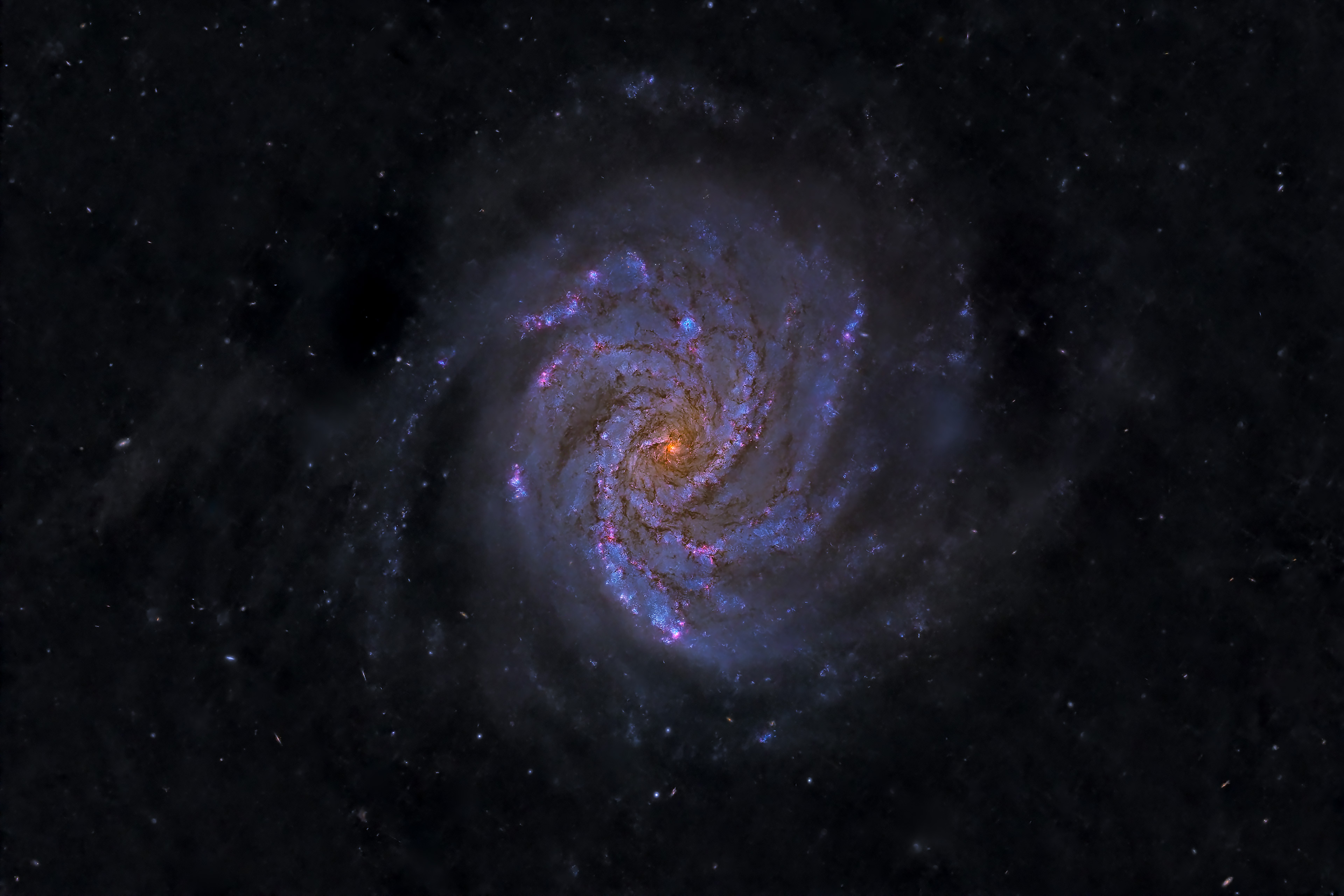
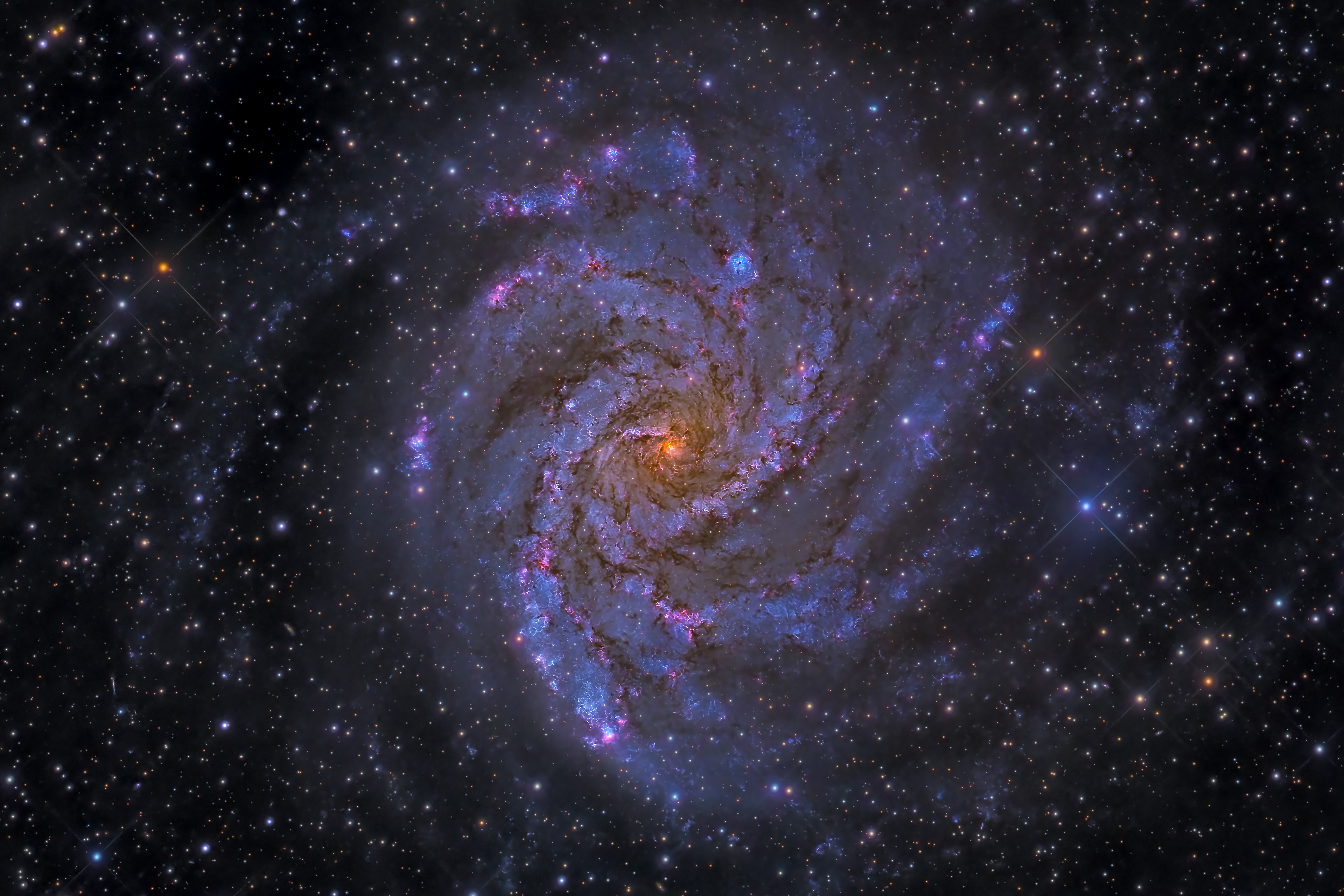
Below Images: The first image below distinguishes foreground
Milky Way stars from the distant features physically associated
with NGC 6946 by removing all the foreground stars. Moving the
mouse over the image brings the stars back! The second image below
shows a zoomed in view of NGC 6946.
The final comparison illustrates nearly a decade of
improvements in imaging equipment, acquisition techniques, and
image processing, with a smooth transition between the original
processing and the latest version demonstrating the remarkable
increase in detail and depth.
Object Statistics:
Constellation: Cepheus (near the Cygnus border), Right
Ascension: 20
h 34
m 52
s,
Declination: +60° 09′ 14″, Apparent Magnitude: 9.6, Size: 11′.5
× 9′.8 (~115,000 light-years diameter), Distance: ~22 million
light-years from Earth, Morphological Type: SAB(rs)cd, Recorded
Supernovae: 10 (1917–2017).