Details: The Tadpole Galaxy
was discovered by the German-born astronomer
William
Herschel on May 14, 1787 and is cataloged as
UGC 10214
and
Arp 188 in
Halton Arp's
famous
Atlas of Peculiar Galaxies. Located approximately
400 million light-years from Earth, the galaxy shines at an
apparent
magnitude of about 14.4 and spans roughly 3.6 × 0.8
arcminutes.
Despite appearing relatively modest in amateur telescopes, it is
actually a massive spiral galaxy approximately 180,000
light-years across—considerably larger than our own
Milky Way.
Its remarkable appearance has made it one of the most
recognizable interacting galaxies ever imaged by the
Hubble Space Telescope.
The Great Tidal Tail:
The Tadpole Galaxy's most distinctive feature is its enormous
tidal tail, extending nearly 280,000 light-years into
space—almost three times the diameter of the Milky Way. This
extraordinary structure formed approximately 100–200 million
years ago when a smaller intruding galaxy passed close to UGC
10214. During this encounter, immense
tidal forces
generated by
gravity pulled vast streams of stars, gas, and dust outward
from the galaxy's disk. Embedded throughout the tail are dozens
of brilliant blue star-forming knots, many of which are enormous
young
star
clusters. Some of these clusters are so massive they may
eventually evolve into compact dwarf galaxies, illustrating how
galaxy collisions can actually create entirely new stellar
systems while simultaneously disrupting existing ones.
The Disturbed Galactic Disk: While the tidal tail
attracts immediate attention, the main body of the Tadpole
Galaxy tells an equally fascinating story. The spiral structure
has been significantly distorted by the encounter, with one side
stretched outward while the opposite side remains comparatively
intact. Unlike many interacting galaxies that experience intense
central
starbursts, the nucleus of UGC 10214 shows surprisingly
modest star-forming activity. Instead, much of the triggered
star formation has occurred throughout the disk and especially
within the tidal tail, where compressed clouds of gas have
collapsed to produce thousands of young, hot blue stars.
The Companion and Nearby Galaxies: Surrounding the
Tadpole Galaxy are several smaller galaxies that add depth and
interest to the field.
PGC 57108 and
PGC 57109
appear as compact background galaxies lying well beyond the
Tadpole itself. Although they are projected nearby in the sky,
they are not believed to be physically interacting with UGC
10214. Another nearby galaxy,
PGC 57087, is also visible
in deep images and contributes to the rich background of distant
island universes that populate this region of Draco. Together
these faint galaxies remind us that every deep astronomical
image contains countless systems spanning vastly different
distances across the observable universe.
The Foreground Star SAO 29805: One of the brightest objects in
the field is the foreground star
SAO 29805, an
A2-type star located within our own Milky Way. Its brilliant
white-blue color contrasts beautifully against the warm tones of
the distant galaxies beyond. Although it appears close to the
Tadpole Galaxy from our perspective, SAO 29805 is merely a
foreground object lying hundreds of light-years from
Earth—millions of times closer than the galaxies in the
background. Diffraction spikes and scattered light from this
bright star often become prominent features in deep
astrophotography of the Tadpole field, providing a striking
visual reminder of the enormous range of distances captured in a
single image.
A Cosmic Collision: The Tadpole
Galaxy represents a textbook example of how galaxy interactions
shape the evolution of the universe. Computer simulations
reproduce its remarkable appearance by modeling the close
passage of a smaller companion through the outer regions of the
galaxy. Rather than direct collisions between individual
stars—which are extraordinarily rare—the interaction is governed
almost entirely by the large-scale effects of
gravity.
Over hundreds of millions of years, these tidal forces
redistribute stars, gas, and
dark matter,
triggering new waves of star formation while permanently
altering the structure of both galaxies involved.
A Window into Galactic Evolution: The Tadpole Galaxy provides
astronomers with a remarkable opportunity to observe galactic
evolution in progress. Similar interactions were far more common
in the early universe when galaxies were packed closer together.
By studying systems such as Arp 188, astronomers gain valuable
insight into how large spiral galaxies grow, how stellar
populations evolve following mergers, and how tidal interactions
can give rise to entirely new star clusters and dwarf galaxies.
What appears today as a beautiful celestial oddity is, in
reality, one chapter in the ongoing story of galaxy formation
throughout the cosmos.
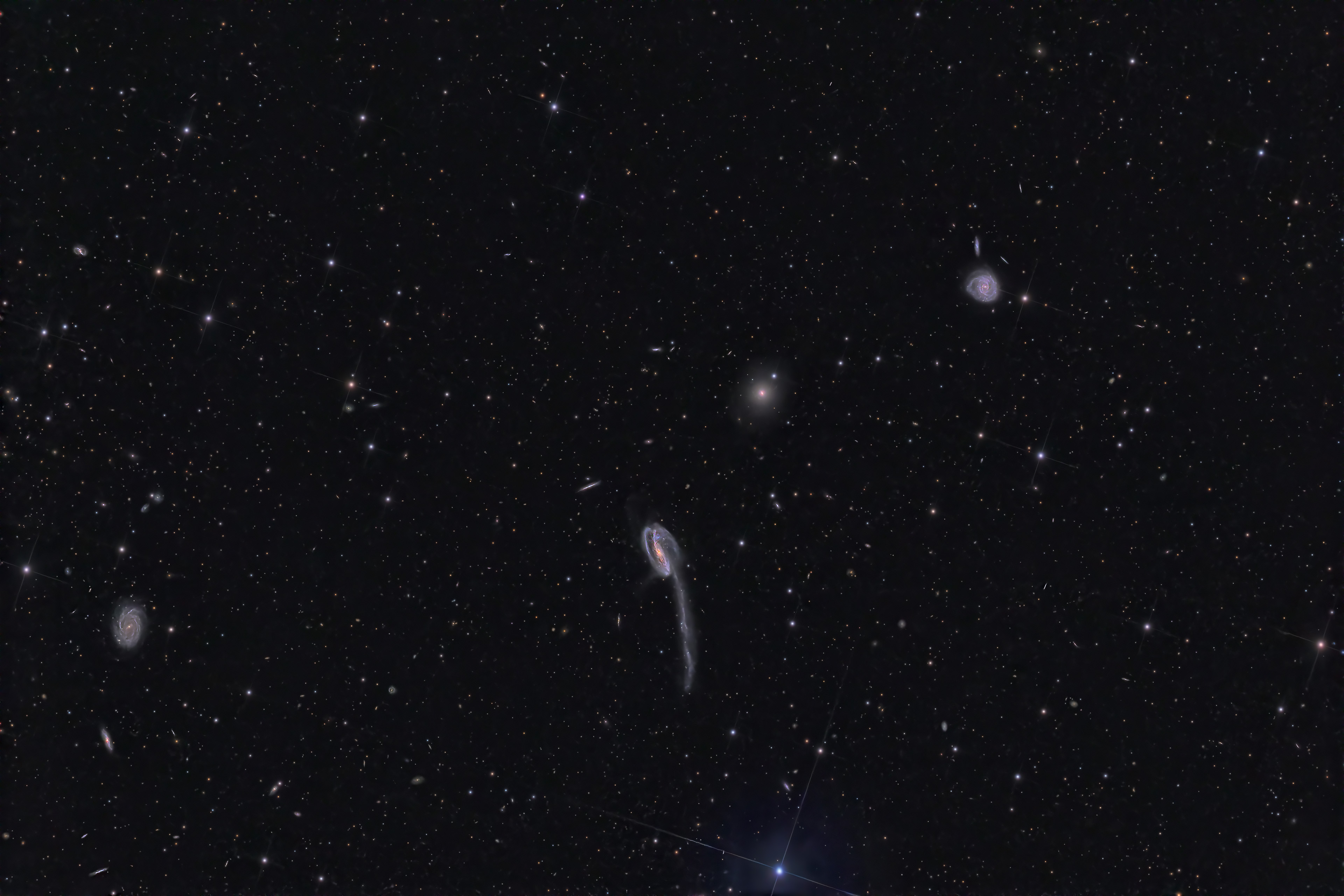
Annotations: In the image
above, hover your mouse or cursor over the image to reveal
annotations highlighting the bright central nucleus, the
dramatically elongated tidal tail, numerous blue star-forming
clusters embedded within the tail, the nearby background
galaxies PGC 57108, PGC 57109, and PGC 57087, along with the
brilliant foreground A2 star SAO 29805. These annotations help
distinguish objects that are physically associated with the
Tadpole Galaxy from those that merely share the same line of
sight.
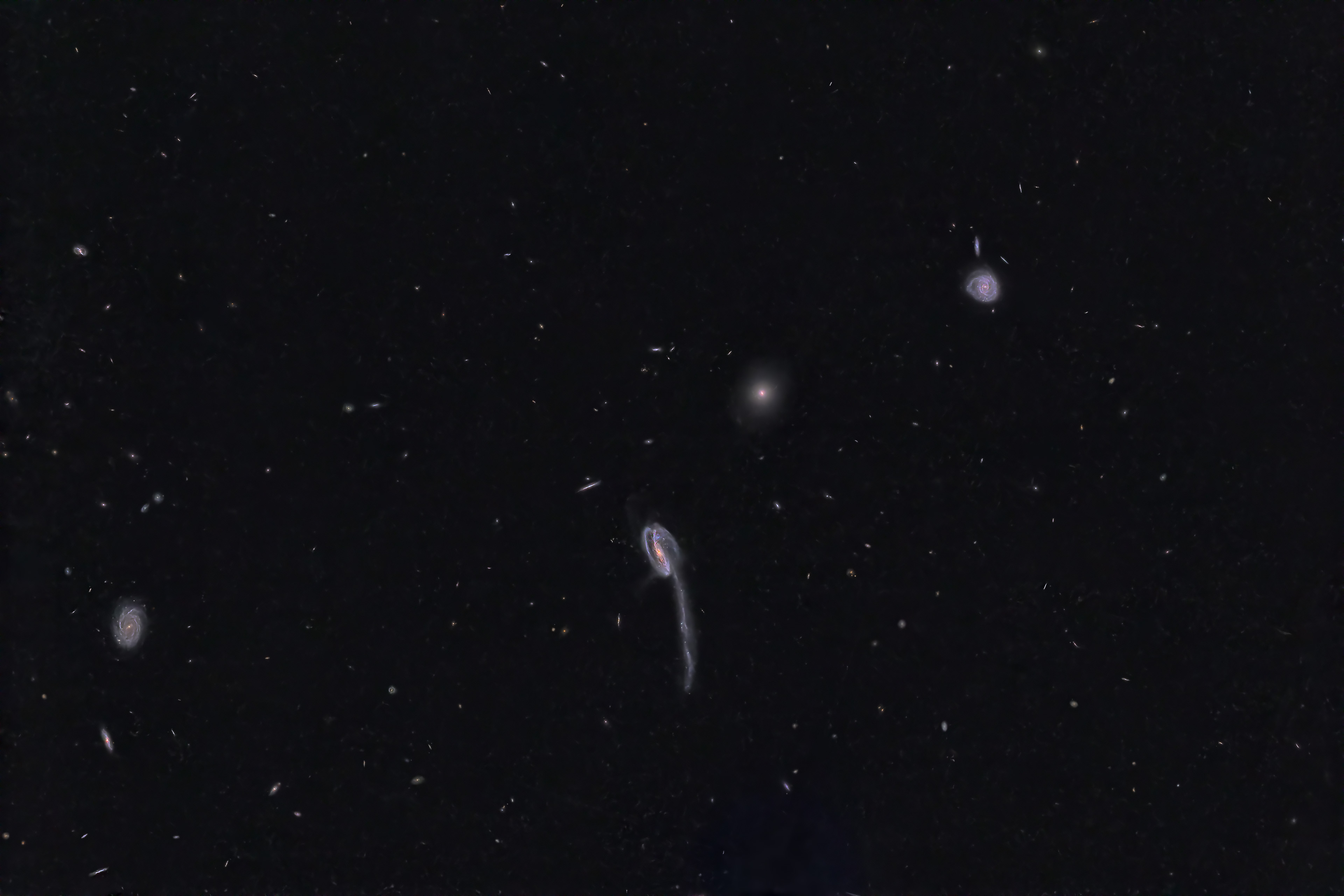
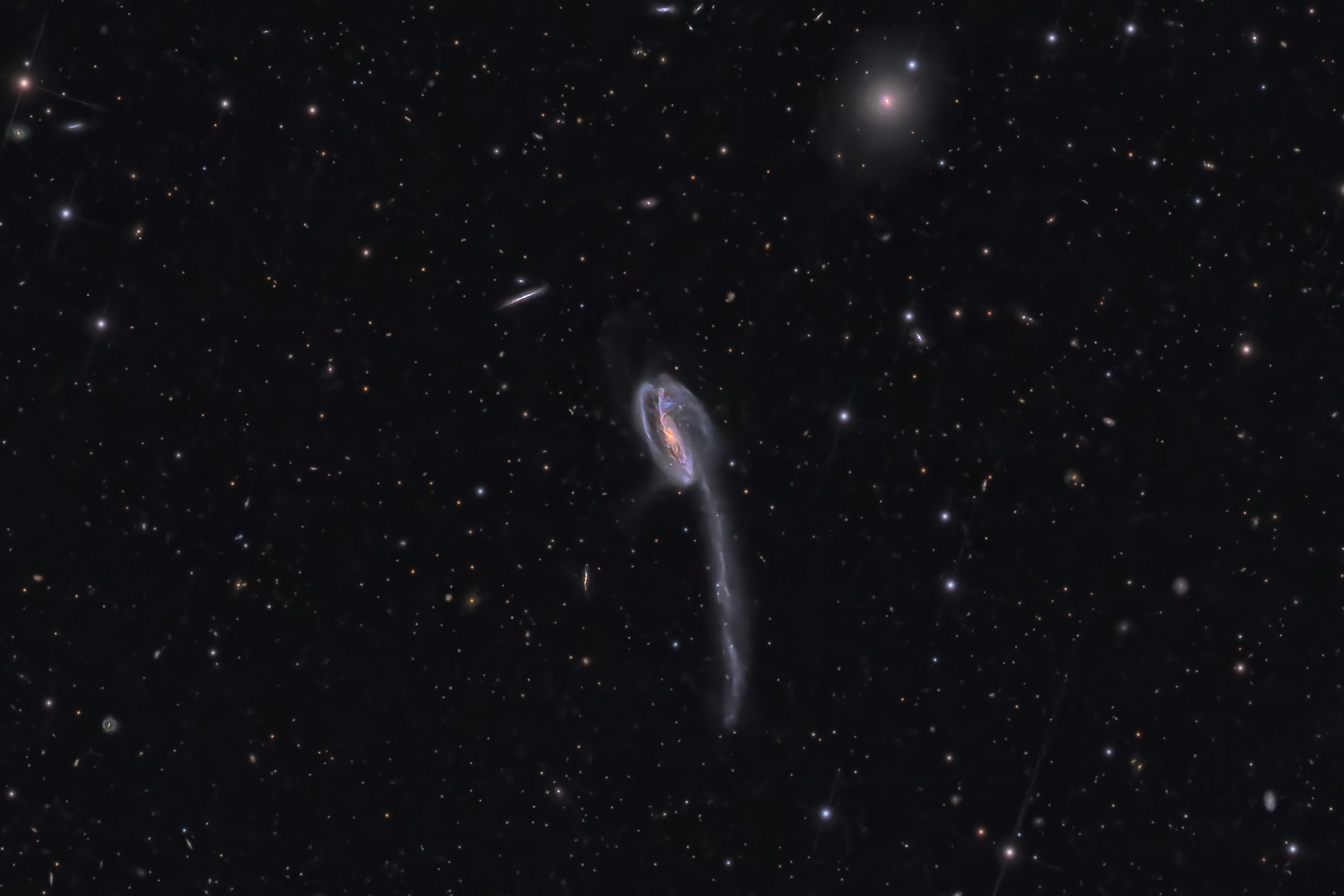
Below Images: The comparison images below
present the same dataset processed using different techniques.
The first is a star-reduced version reveals the intricate
structure of the Tadpole Galaxy and its extensive tidal tail
with greater clarity by minimizing foreground stars from the
Milky Way; hovering over the image brings all the stars back.
The second image below shows a zoomed in view of the Tadpole
galaxy itself for additional structure close-up; hovering over
this image makes the stars once again disappear. Finally the
last image is a comparison of original processing on this image
nearly 10 years ago and latest processing. Hovering a mouse over
transitions between the two comparisons.
Object Statistics: Constellation: Draco, Right Ascension: 16
h
06
m 03
s, Declination: +55° 25′ 32″,
Apparent Magnitude: 14.4, Size: 3′.6 × 0′.8 (~180,000
light-years diameter), Tidal Tail Length: ~280,000 light-years,
Distance: ~400 million light-years from Earth.