IC 5146 ~ Cacoon Nebula
| Optics: |
Ritchey–Chrétien 20" F/8.2 (4166mm FL) |
Processing: |
PixInsight, Photoshop |
| Camera: |
SBIG STXL-11000 with Adaptive Optics |
Date: |
Oct-Nov 2026 |
|
11 Megapixel (4008 x 2672 16-bit sensor) |
Location: |
Columbus, Texas |
| Exposure: |
LRGB = 55:110:70:100 minutes |
Imager: |
Kent E. Biggs |
IC 5146 - The Cocoon Nebula: A Cosmic Nursery Wrapped in
Starlight and Shadow. Imagine a brilliant young star
illuminating an enormous cloud of cosmic dust, transforming its
surroundings into a glowing cocoon of crimson hydrogen, delicate
blue reflection nebulosity, and intricate dark filaments. Beyond
this luminous cloud, a long, winding river of darkness cuts
through the crowded star fields of the Milky Way, while a
separate, compact blue reflection nebula glimmers nearby. This
is
IC 5146,
the magnificent
Cocoon
Nebula, accompanied by the reflection nebula
vdB 147 and the vast dark cloud
Barnard 168. Located in the constellation
Cygnus, the Swan, in a particularly rich region of the
Milky Way,
this extraordinary complex brings together several of the most
beautiful and scientifically revealing features of the
interstellar medium. Glowing gas reveals the energy of young
stars; blue nebulosity reveals the scattering of starlight by
dust; and dark clouds conceal the colder material from which
future generations of stars may form. What appears to be a
single colorful cloud is actually a complicated environment of
stars, gas, dust, and ongoing stellar evolution, approximately
3,300 light-years from Earth.
The Cocoon is especially
fascinating because its central illuminating star,
BD +46° 3474, is not alone. It belongs to a young stellar
population commonly associated with the open cluster
Collinder
470. Many other young stars occupy the surrounding region,
while some remain deeply embedded in obscuring dust. The cluster
and its nebula offer a glimpse of a stellar nursery at work,
where the formation of stars and the radiation from newly formed
stars interact to shape the very clouds from which they emerged.
And there is a wonderful surprise in the surrounding field:
vdB 147, a separate reflection nebula illuminated by another
young star, and Barnard 168, a long dark cloud extending far
beyond the bright Cocoon itself. Together, these three objects
tell a story of light and darkness, creation and transformation,
written across the star-filled landscape of our galaxy.
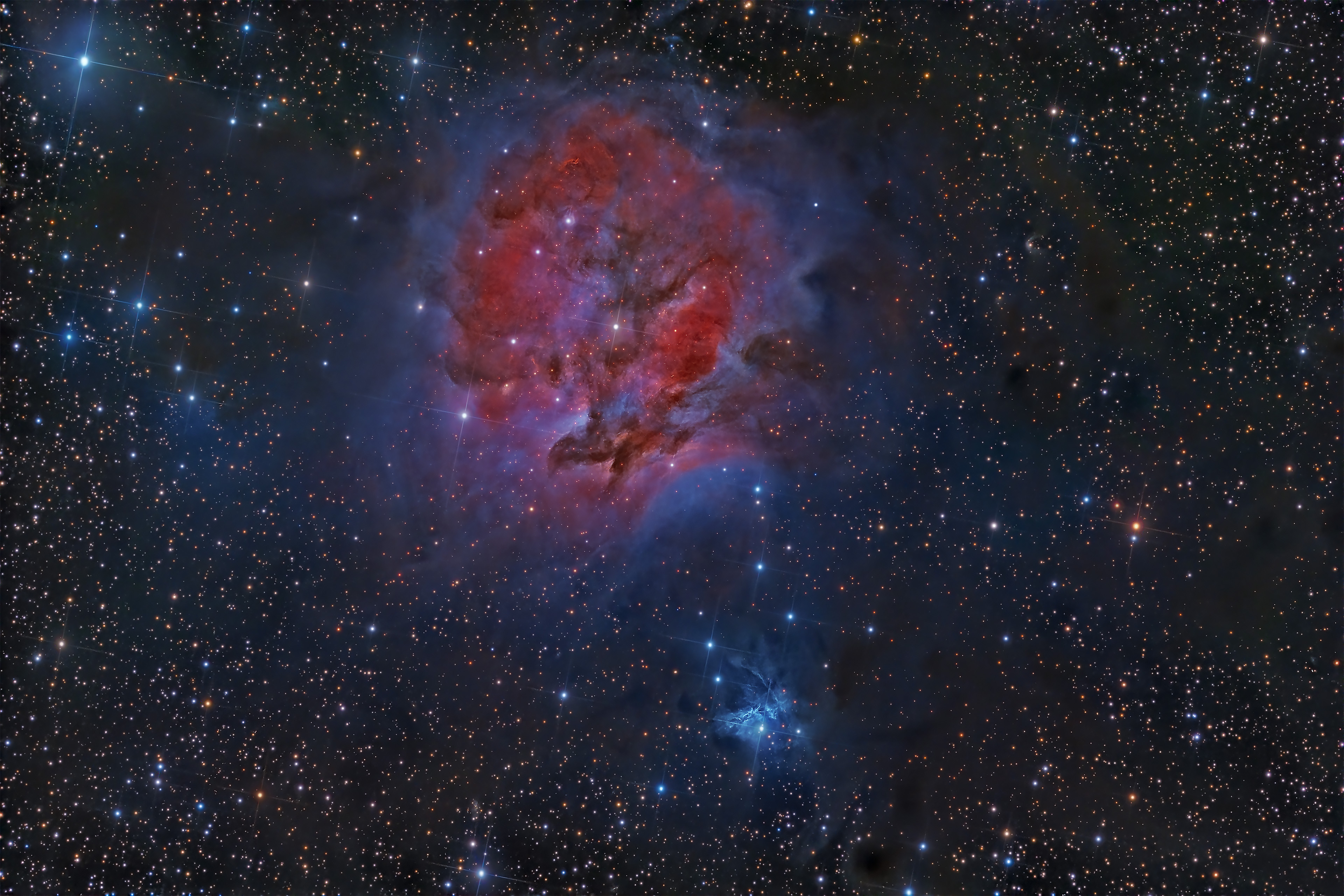
The Brilliant Cocoon Suspended in a Sea of Stars. In the image above, the
full-color view with the stars visible and an annotated overlay
revealed by hovering the mouse over the image. Explore the
annotations to identify the principal illuminating star, the
glowing cloud, the dark dust lanes, the compact blue reflection
nebula, and the surrounding field of stars. The image is more
than a portrait of a beautiful nebula: it is a map of several
distinct astronomical environments occupying the same field of
view. The most immediately striking feature is the large
red and pink cloud in the upper-central part of the image. This
is the principal emission region of the Cocoon Nebula. Its
irregular surface brightness, dark intrusions, and brighter
knots reveal that the cloud is not a uniform ball of gas.
Instead, its appearance reflects the distribution of gas and
dust, the penetration of energetic radiation, and the complex
geometry of the material surrounding its young stars.
The
blue-violet haze surrounding the red cloud provides a dramatic
contrast. Some of this light is produced by reflection: dust
grains scatter the light of nearby stars toward our line of
sight. The blue appearance is particularly associated with the
wavelength dependence of scattering, although the actual color
also depends on the illuminating stars, dust properties, and the
image's filter combination and processing. The Cocoon therefore
displays two complementary ways that a nebula becomes visible:
gas can emit light after being energized, while dust can
redirect light produced elsewhere. The most conspicuous
dark structures cross the lower and central portions of the
bright cloud. These are obscuring dust lanes, where dense
material absorbs and scatters visible light. Rather than being
empty gaps, these regions contain interstellar material that can
be rich in molecular gas and dust. Some of the cloud's densest
regions are difficult to study in visible light precisely
because they hide the stars and gas behind them. Notice,
too, the countless stars scattered across the image. Some are
members of the young stellar population associated with IC 5146;
others are foreground stars in our own galaxy or more distant
background objects. Their apparent proximity to the nebula does
not, by itself, establish membership. Proper motions,
parallaxes, spectra, and other measurements are needed to
determine which stars share the nebula's distance and motion.
The Principal Illuminating Star BD +46° 3474. One of
the most important objects to identify in this image is
BD +46° 3474, the principal illuminating star of the Cocoon
Nebula. It is a hot, young, approximately B1-type star whose
energetic radiation plays a major role in producing the bright
emission region. It is commonly listed at approximately ninth to
tenth magnitude, with the exact quoted value depending on the
catalog and photometric band. The star's ultraviolet
radiation can remove electrons from hydrogen atoms in the
surrounding gas, creating an
H II region
of ionized hydrogen. When electrons recombine with protons and
cascade through atomic energy levels, the gas emits
characteristic wavelengths, including the famous deep-red
H-alpha line
at approximately 656.3 nanometers. This process helps produce
the reddish glow so prominent in the Cocoon. The star is
not the only star within the nebula. The associated young
cluster contains many stars, and infrared surveys reveal
additional young stellar objects that are obscured at visible
wavelengths. The Cocoon is therefore a stellar nursery, not a
solitary star surrounded by an otherwise empty cloud. A
useful distinction for the annotations is to label BD +46° 3474
as the
principal illuminating star, rather than implying
that it is the only star in the nebula. Other stars may
contribute to the reflected light, and some may be unrelated
foreground or background objects.
Emission Nebula versus Reflection Nebula - Two Different Kinds of Light.
The red emission and blue reflection regions in the image
are a beautiful demonstration of how the same interstellar
environment can produce contrasting colors through different
physical processes. An
emission
nebula shines because its gas has been energized, often by
the ultraviolet radiation of hot young stars. In the Cocoon,
ionized hydrogen is an important source of the red H-alpha
emission. Other emission lines and continuum contributions may
also influence the final color, depending on the filters and
processing used. A
reflection nebula, by contrast, does not need to generate
the visible light itself. Dust grains scatter light from nearby
stars. Shorter visible wavelengths are often scattered more
efficiently, making many reflection nebulae appear blue. The
color is not an absolute rule, however; the illuminating star's
spectrum, the dust's properties, and the viewing geometry all
matter. The boundary between the red and blue regions is
not necessarily a sharp physical wall. It can reflect changing
gas density, dust concentration, illumination, and the geometry
of the cloud. The delicate transition visible in this image is
one reason the Cocoon is such a rewarding object for deep
astrophotography.
Dark Dust Lanes — The Sculpted Interior of the Cocoon. Look closely at the dark,
branching structures cutting into the lower half of the bright
red cloud. Their sharply contrasting appearance is one of the
defining features of your image. These structures are best
described as
dust
lanes or dark filaments: concentrations of material that
obscure the luminous gas behind them. Interstellar dust
is made of tiny solid particles mixed with gas. Although it
represents only a small fraction of the total mass of the
interstellar medium, it strongly affects the appearance of
astronomical objects by absorbing and scattering light. Dense
clouds may be nearly opaque in visible wavelengths while
allowing infrared and longer-wavelength radiation to pass
through more readily. The dark shapes are therefore not
simply holes in the nebula. They can trace the uneven
distribution of the material from which stars form. Some dense
structures may contain cold molecular gas, compact cores, and
early-stage stellar objects. However, an optical image alone
cannot establish the physical properties of every individual
filament; infrared and molecular-line observations provide
important complementary evidence. These dark features
also demonstrate why the Cocoon is more than a glowing cloud.
The same material that blocks the visible light is part of the
environment in which stars are born, while the radiation from
existing young stars gradually changes the surrounding cloud.
Collinder 470 - A Young Cluster Inside the Cocoon.
Embedded in the Cocoon Nebula is the young open cluster
Collinder 470. An
open
cluster is a group of stars that formed from a common
molecular cloud and remain associated in space, at least for
part of their lives. Unlike a dense globular cluster, an open
cluster typically contains a comparatively loose arrangement of
stars. The cluster's young stars are important to the
nebula's appearance and evolution. The hottest members supply
energetic radiation that illuminates and ionizes the surrounding
material. At the same time, stellar winds and radiation pressure
can redistribute gas and dust. Over time, these processes can
disperse the natal cloud, leaving the stars increasingly exposed
to view. The region is also home to much fainter young
stellar objects, including stars still surrounded by disks or
envelopes of material. Such objects may be difficult to identify
in a visible-light image because their radiation is absorbed by
dust and re-emitted at infrared wavelengths. Observations with
infrared telescopes have revealed a much richer young stellar
population than can be inferred from the brightest visible stars
alone. It is worth noting that catalog names have
sometimes been used inconsistently: IC 5146 is commonly used for
the combined Cocoon region, while Collinder 470 identifies the
associated star cluster and Sh 2-125 is a widely used
designation for the emission nebula. The labels overlap in
popular usage, so specifying whether one means the cluster, the
gas, or the complete complex makes the description more precise.
IC 5146 ~ Cacoon Nebula Annotated Field!
The Annotated Field: Coordinates, Stars, and Deep-Sky Objects.
The Image above presents the same
original image with annotations identifying celestial
coordinates, stars, and deep-sky objects. Hover over the image
to explore the catalog labels and compare the positions of
individual stars with the nebular structures. This view is
especially useful for distinguishing the primary illuminating
star from other stars projected against the cloud and for
identifying objects that have their own catalog designations.
The coordinates in the overlay use the familiar astronomical
coordinate system of
right
ascension and
declination.
Right ascension measures position eastward along the celestial
equator in hours, minutes, and seconds; declination measures
angular distance north or south of the celestial equator in
degrees. Together, these coordinates allow astronomers to
identify a celestial object precisely and compare observations
made with different telescopes. A catalog label does not
necessarily imply that the labeled star belongs to the Cocoon's
cluster. A bright star can lie in front of the nebula, behind
it, or within the same star-forming region. Establishing
membership generally requires distance estimates from
Gaia,
proper-motion measurements, and, where available, radial
velocities and spectroscopic information. The overlay
also helps reveal how many separate astronomical objects can
share a single field of view. The stars belong to different
populations and distances, while the nebulosity itself includes
emission, reflection, and obscuring material. The apparent unity
of the scene is the result of looking through a
three-dimensional section of the Milky Way from our position on
Earth.
vdB 147 - A Separate Reflection Nebula in the
Same Field. One of the most intriguing features in the
lower part of the image is the small, concentrated blue nebula
cataloged as
vdB 147. Unlike the large red Cocoon, this is a separate
reflection nebula, illuminated by a different star and occupying
a distinct location in the surrounding star field.The
prefix
vdB stands for
Sidney van den Bergh, the Dutch-Canadian astronomer who
compiled a catalog of reflection nebulae in the 1960s. His
catalog, published in 1966, helped organize these often subtle
objects, which are visible primarily because they scatter light
from nearby stars. Thus, vdB 147 means the 147th object in van
den Bergh's reflection-nebula catalog; the designation does not
refer to a star number or a type of emission nebula. The
illuminating star of vdB 147 is
BD +46° 3471, also known as
V1578 Cygni. It is distinct from BD +46° 3474, the principal
illuminating star of the Cocoon. BD +46° 3471 is associated with
young stellar activity and has been described as a variable,
emission-line star. Its light illuminates the surrounding dust,
producing the compact blue reflection nebulosity visible in your
image. This distinction is especially useful for your
annotations: the main Cocoon and vdB 147 should be labeled as
two different nebular objects, with their own illuminating
stars. Although they appear together in one photograph, they are
not simply two bright patches of a single uniform cloud.
V1578 Cygni - The Star Lighting vdB 147. The
star associated with vdB 147 has the variable-star designation
V1578 Cygni. Variable stars
change in apparent brightness for a variety of reasons,
including pulsation, eclipses, or changes in the material
surrounding a young star. In this case, the star is associated
with young stellar activity and has been described as an
emission-line object. Its cataloged brightness is around
magnitude 10, with small variations reported in the literature.
Its stellar classification and variability make it an
interesting object in its own right, rather than merely a point
of light illuminating a reflection nebula. The blue cloud around
it reveals scattered starlight, while the star's own spectrum
and variability provide additional clues about the physical
processes occurring in the young stellar environment. The
presence of vdB 147 alongside the Cocoon makes this image
particularly rewarding: it allows a comparison between a large,
mixed emission-and-reflection complex and a smaller reflection
nebula whose visible light comes predominantly from scattering.
Barnard 168 - The Long Dark River Through Cygnus.
Beyond the Cocoon, the dark lane extends through the
star-rich Milky Way field. This is
Barnard 168, usually abbreviated B168, a long, sinuous
dark nebula
cataloged by the pioneering American astronomer
Edward Emerson Barnard. A dark nebula is a cloud of
gas and dust that appears as a silhouette against a brighter
background. Unlike an emission nebula, it does not stand out
because it glows strongly in visible light. Instead, it absorbs
and scatters the light of stars behind it, creating a
conspicuous dark lane through the Milky Way's crowded star
fields. B168 is much larger than the bright Cocoon
itself. It extends roughly one to two degrees across its longest
dimension, depending on the adopted boundary, and is often
quoted at approximately 120 by 45 arcminutes. That makes it an
excellent example of how a small, bright nebula can be embedded
in a much larger dark molecular cloud. The Cocoon lies near the
eastern end of this extended lane, while the obscuring material
continues well beyond the field of the main nebula image.
Barnard's catalog was an important step in recognizing that
the apparent absence of stars in certain regions of the Milky
Way could be caused by obscuring material rather than by genuine
empty spaces. His photographic studies helped establish dark
nebulae as physical objects in their own right, and later
infrared and radio observations revealed that many such clouds
contain dense molecular gas and regions of active or potential
star formation. The relationship between B168 and IC 5146
is particularly interesting. The dark cloud is associated with
the Cocoon region, although the exact distance and
three-dimensional structure of all parts of the extended cloud
are not determined simply from the optical image. If the entire
structure lies at approximately the Cocoon's distance, its
enormous angular extent corresponds to a physical scale of many
tens to more than one hundred light-years.
IC 5146 ~ Cacoon Nebula Without Stars!
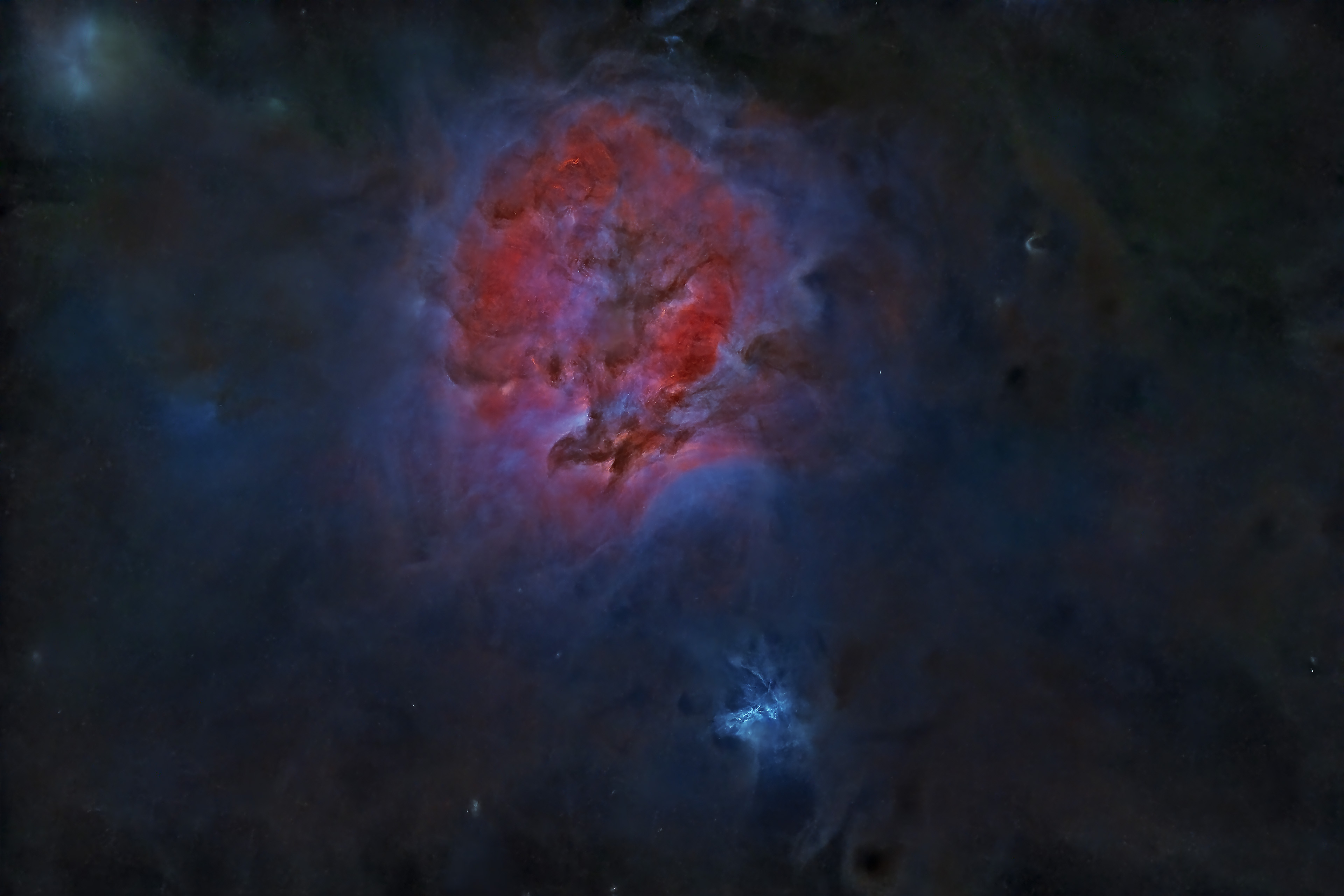
The Starless View: Revealing the Nebula's Subtle Structure.
The image above presents the same image with the stars removed,
while hovering the mouse over it brings the stars back. This
comparison makes it easier to study the shape and continuity of
the nebula without the visual distraction of hundreds of stellar
points and their diffraction spikes. With the stars
suppressed, the broad red emission region becomes easier to
follow, as do the wispy blue outer regions and the dark lanes
that divide the cloud. The compact reflection nebula vdB 147
also becomes easier to distinguish from the surrounding star
field. The dark cloud associated with B168 can be appreciated as
a broad obscuring structure rather than simply a gap between
bright stars. Star removal is a presentation and
processing technique, not a separate observation of the nebula.
The original image remains essential for checking whether faint
structures are genuine, and the star-reduced version should be
treated as a complementary view that makes certain
low-surface-brightness features easier to inspect. The most
convincing details are those that remain consistent between the
original data, the processed image, and observations made at
other wavelengths. The contrast between the two views
also reminds us that stars and nebulosity represent different
physical components. The stars are compact sources of light,
while the nebula is extended material distributed across a much
larger volume of space. Separating them visually helps tell the
story of the gas and dust without implying that the stars have
ceased to exist or that the underlying astrophysical scene has
changed.
The Science of a Stellar Nursery - From Cold
Dust to New Stars. The Cocoon Nebula is part of a
broader star-forming environment. Stars form when dense regions
of cold molecular gas and dust become gravitationally unstable
and collapse. As a protostar develops, material can accrete onto
it through a surrounding disk, while outflows and radiation
begin to affect the natal cloud. The youngest stars are
often difficult to see in visible light because they remain
embedded in dense dust. Infrared observations can penetrate
these obscuring regions more effectively, revealing objects that
would be invisible or extremely faint in an optical image.
Studies of IC 5146 have identified a substantial population of
young stellar objects, including low-mass stars and objects with
infrared excesses indicative of circumstellar material.
Once massive, hot stars begin emitting strong ultraviolet
radiation, the surrounding gas becomes ionized and the cloud's
appearance changes dramatically. Bright emission regions
develop, dust scatters starlight, and stellar winds can shape
cavities and irregular boundaries. The Cocoon's red and blue
structures are visible evidence of this interaction between
young stars and their environment. This process is not
instantaneous. Star formation, cloud dispersal, and stellar
evolution occur over timescales ranging from thousands to
millions of years. The light captured in this image began its
journey thousands of years ago, but the structures themselves
record a much longer history of the cloud and its stars.
Historical Discovery - Barnard, Wolf, and the Cocoon's
Early Observers. The history of IC 5146 reflects the
transition from visual observing to photographic astronomy.
Edward Emerson Barnard photographed the Cocoon region on
October 11, 1893, using a six-inch Willard lens at Lick
Observatory.
Max Wolf independently photographed the field in 1894, and
later publicized the object in his work on unusual nebulae.
Thomas
Espin also observed the nebula visually in the late
nineteenth century. Wolf's 1904 paper,
Remarkable
Nebula in Cygnus, discussed the nebulosity and the adjacent
dark lane. These early photographs were important because the
Cocoon is not merely a compact point-like object: its irregular
shape and faint surroundings are much easier to appreciate in a
photographic record than through a small telescope at the
eyepiece. Barnard's work on dark nebulae helped establish
that the starless lanes in the Milky Way are not simply empty
regions. His catalog of dark objects, published in its major
form in 1927, remains an important reference for observers and
researchers. B168 preserves this legacy, connecting a modern
deep-sky image with more than a century of astronomical
exploration. For historical context and object notes,
consult the
Index Catalogue notes for IC 5146, the
Astropix discussion of IC 5146 and Barnard 168, and the
SIMBAD entry for IC 5146.
Further Reading and Astronomical References. For a concise scientific
description of the Cocoon and its central star, see the
University of Zurich's Cocoon Nebula overview. It discusses
the interaction of the bright young star with the surrounding
gas and dust, including the red emission and blue reflected
light. For the separate reflection nebula and its
illuminating star, see the detailed
IRIDA Observatory page on IC 5146 and vdB 147. The page
identifies vdB 147, BD +46° 3471, and V1578 Cygni, and provides
an example of a close view of the reflection nebula. For
catalog data, coordinates, and references to published studies,
use
SIMBAD for IC 5146,
SIMBAD for vdB 147, and
SIMBAD for Barnard 168. For star identification and
cross-matching,
ESA's Gaia mission is especially useful.
IC 5146 - Astronomical Statistics. Common name:
Cocoon
NebulaCatalog designations: IC 5146, Caldwell 19, Sh
2-125, LBN 424, Collinder 470
Object type: Emission and
reflection nebula associated with an open star cluster
Constellation:
CygnusRight Ascension (J2000): 21h 53m 29.3s
Declination (J2000): +47° 14′ 46″ (approximately; catalog
centers vary)
Apparent magnitude: approximately 7.2 for the
commonly quoted combined object; this is not a point-source
stellar magnitude
Angular size: approximately 10–12
arcminutes across, depending on the adopted boundary
Distance: approximately 3,300 light-years, with published
estimates varying by method
Approximate physical diameter:
about 10–12 light-years across for a 10–12 arcminute visible
extent at 3,300 light-years
Principal illuminating star: BD
+46° 3474, a hot, young B-type star
Associated star cluster:
Collinder 470Notable features: Red H-alpha emission,
blue reflection nebulosity, dark dust lanes, embedded young
stellar objects
Historical note: Photographed by Edward
Emerson Barnard in 1893; independently photographed by Max Wolf
in 1894; discussed in Wolf's 1904 paper
vdB 147 - Astronomical StatisticsCatalog designation:
vdB 147Catalog meaning: Object 147 in Sidney van den
Bergh's reflection-nebula catalog
Object type: Reflection
nebula
Constellation:
CygnusApproximate position (J2000, using the
illuminating star): RA 21h 52m 34.1s, Dec +47° 13′ 44″
Illuminating star:
BD +46° 3471, also
V1578 CygniApproximate stellar magnitude: around 10.1,
with reported variability; this refers to the star, not the
nebula's integrated brightness
Distance: approximately 3,300
light-years in published descriptions, although the distance and
physical association should be treated as estimates
Angular
size: A single standard angular diameter is not consistently
quoted; the visible reflection nebulosity is compact and its
measured extent depends on the image and surface-brightness
threshold
Physical size: Depends on the adopted angular
boundary and distance; no single precise diameter is given here
Notable features: Blue scattered starlight, a young
emission-line illuminating star, and a compact reflection cloud
Barnard 168 - Astronomical Statistics
Catalog designation:
Barnard 168 (B168)Object type: Dark nebula / obscuring
interstellar cloud
Constellation:
CygnusApproximate position (J2000): RA 21h 53m 18s, Dec
+47° 16′ (catalog coordinates are representative of the cloud,
not a sharply defined center)
Angular size: approximately 120
× 45 arcminutes in commonly cited observing references;
boundaries vary with the method used
Distance: often assumed
to be similar to the Cocoon region, roughly 3,300–4,000
light-years, but the full cloud's distance structure is
uncertain
Approximate physical extent: if located at 3,300
light-years, 120 × 45 arcminutes corresponds to roughly 115 × 43
light-years; this is a scale estimate, not a precision
measurement
Apparent magnitude: Not meaningfully defined in
the same way as for a star or luminous nebula, because B168 is
identified primarily by the background starlight it obscures
Historical note: Cataloged by Edward Emerson Barnard; its
dark-cloud nature was discussed in early twentieth-century
photographic studies
Notable features: Long, sinuous dust
lane; dense obscuring material; association with the Cocoon
star-forming region
A Final Perspective - Light, Shadow, and the Birth of Stars.
The Cocoon Nebula is a
remarkable reminder that the most beautiful astronomical objects
are often places of profound physical activity. BD +46° 3474
illuminates the gas, creating a glowing red emission region,
while surrounding dust scatters starlight into blue reflection
nebulosity. Dark lanes reveal denser clouds that obscure the
light behind them and preserve material associated with the
birth of stars. Beyond the main Cocoon, vdB 147 offers a
separate example of a reflection nebula, while Barnard 168
stretches into the Milky Way as a giant river of cosmic shadow.
These structures are not static decorations. Young stars
evolve, radiation reshapes their environment, and dense
molecular material continues to collapse or disperse. The light
reaching us today began its journey thousands of years ago,
while the cloud and its stellar population have been evolving
for far longer. In this single field, the universe
displays the interplay of creation and transformation: stars
born from clouds, clouds illuminated by stars, and dust that
hides as much as it reveals. The Cocoon, vdB 147, and Barnard
168 together form a spectacular portrait of the living, changing
interstellar medium of our own galaxy.