Overview:
NGC 1360 is
a
planetary nebula that lies in the direction of the
constellation
Fornax, the furnace. Fornax is a modern constellation named
by the French astronomer Nicolas Louis de Lacaille in the 18th
century. Surrounding Fornax is the constellation
Eridanus which in contrast is one of the original 48
constellations named by the Greco-Roman astronomer in the 2nd
century AD. NGC 1360, also known contemporarily as the Robin’s
Egg Nebula, has been identified as a planetary nebula due to its
light emission in oxygen bands (OIII) of the visible spectrum
resulting in its strong blue color.
Details: NGC
1360 was discovered in 1868 the German astronomer,
Friedrich August Theodor Winnecke, who was primarily
searching for comets. Comets have orbits around the sun causing
them to move against the background stars, therefore, he
cataloged fixed objects such as NGC 1360 to prevent mistaking
them for comets.
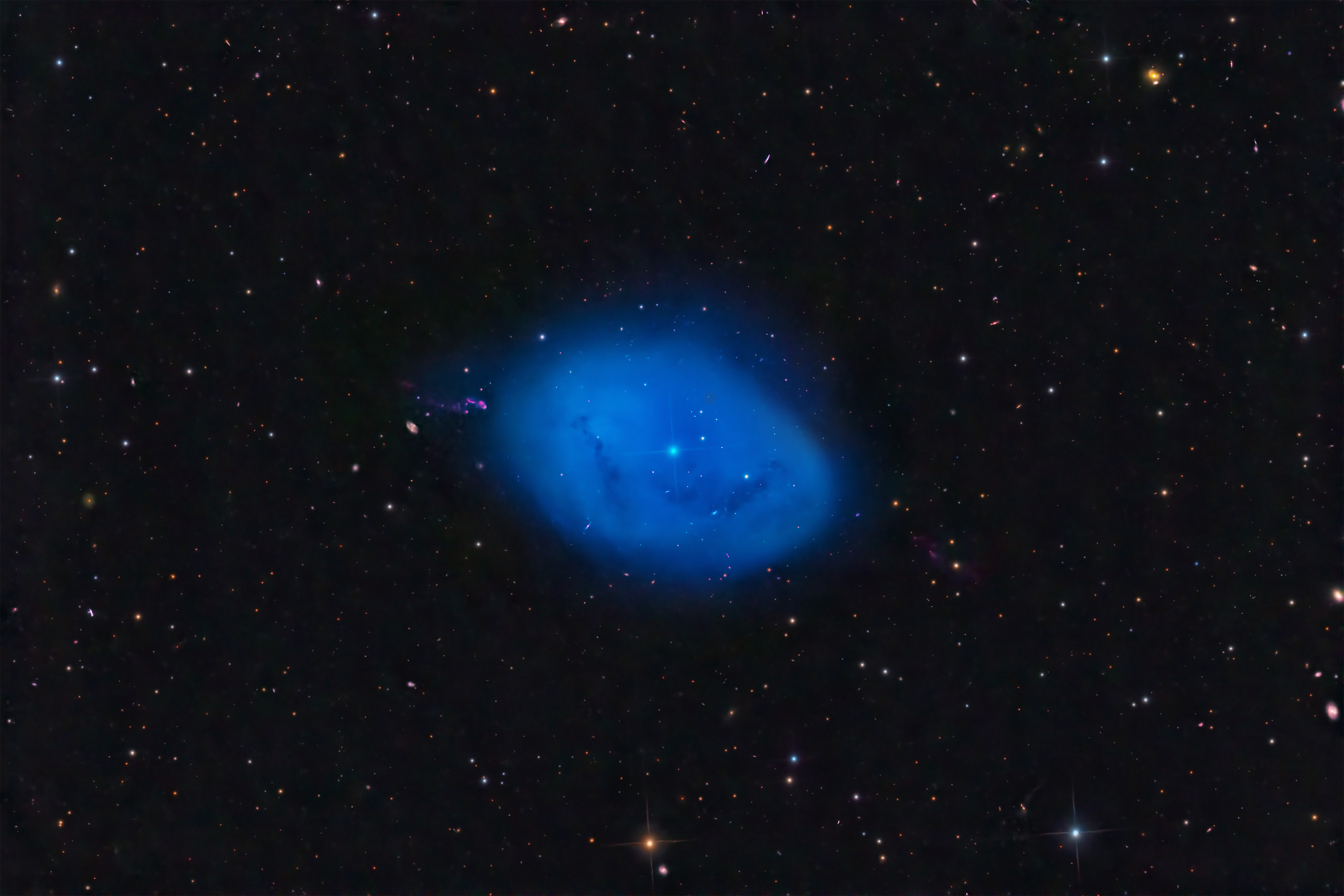
Central Star: Clearly visible in the middle of the nebula
is the blue-green
central star. Since 1977, this central star has been
suspected of being a
binary star
consisting of two stars gravitationally bound to each other and
orbiting one another. Forty years later and confirmed in
2017-18, the central binary star consists of both an unsual
low-mass
O-type star and a
white dwarf.
The white dwarf is what caused the cloud of oxygen rich gas with
a relatively gentle process of sluffing off its outer layers
until only a dense earth-size dwarf star remains, in this case,
with 0.7 times the mass of our sun. The O-type star was
apparently minimally impacted by this expulsion of gas, although
it is unusualy that an O-type star has such a small mass at 0.5
times the mass of our sun. Typical O-type stars are 20 times or
more the mass of the sun.
Surrounding NGC 1360’s blue
nebula are fragments of reddish material believe to have been
ejected from the white dwarf star before it began to expel its
outer shells forming the blue nebula. Of
particular note are the jets of red material at either ends of
the long edge of the elongated nebula. This
red material is primarily ionized hydrogen emitting light in the
red hydrogen-alpha (Hα) emission line. This is in contrast to
the nebula’s blue light emitted in the oxygen III (O3) emission
line. Note the seemingly smooth and relatively homogeneous
nature of the bluish cloud of gas from its central star to the
edge of the nebula. Normally, planetary nebulae have shells of
gas with a central void area as is evident in
M57, The Ring Nebula! The void is evidence of a
stellar
wind pushing the shells away from the central star. However,
NGC 1360 shows no evidence of such shells. Visible in the blue
cloud of the expanding nebula are darker clumps of denser,
cooler gas and dust that block light from the brighter, OIII
ionized gas behind them. These “knots” are referred to as
low-ionization structures (LIS).
The distance to NGC
1360 is between 1200-1800 light years and with dimensions of 11
by 7.5
minutes of arc, it is about 30 by 20 light years in size. It
expands at a rate of 20-40 kilometers per second and, assuming a
constant expansion, originated about 300,000 years ago when the
white dwarf began dissipating vast amounts of material into
space!
Annotations. In the image above, hover a
mouse or curser over the image to show annotations of the
Robin’s Egg Nebula, with several enlarged insets identifying
interesting features! Clicking on the image displays a full
screen view of the nebula without animations that can be zoomed
in further as desired. Starting on the far left are two enlarged
insets of distant galaxies PGC 776482 and 775793, while on the
far right is distant galaxy pair PGC 778645 and 778674. Upper
center of the image and proceeding clockwise are the jets of
hydrogen and nitrogen emitted by the central star, now and white
dwarf, likely before the blue shell was formed. Likewise, ther
can be seen small red knots of material all around the edges of
the nebula, particularly at its visual bottom. Proceeding
clockwise is an enlarged inset of the central star, noting that
the bright cross-like spikes are cause by the telescope and not
the object itself. Finally, is an enlarged inset of distant
spiral galaxy PGC 775013. Viewing the blue nebula closely,
visible through its center are more distant galaxies and stars
seemingly with a blue cast due to the nebula acting as a blue
filter.
Below Images: The image below is the same
image as above but processed to remove all stars except for the
central star that belongs to the nebula. Using a mouse to hover
over the image brings all the stars back. Finally, the last
image below is a zoomed in version of the nebula with and
without stars!
Object Statistics: Constellation:
Sculptor, Right Ascension: 03h 33m 14.6s, Declination: -25° 52'
18”, Apparent Magnitude: 9.4, Size: 11’.0 x 7’.5 (30 light-years
diameter), Distance 1200-1800 light-years.