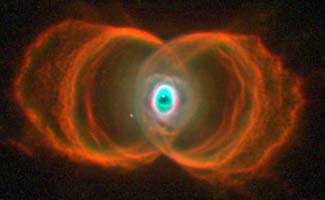
Details: At a distance of about 1600
light-years
and about 4 light-years across, Jones-Emberson 1 has a low
surface brightness and a faint, very blue central star, a
white dwarf
and all that remains of the original star. The white dwarf
formed when its progenitor star consumed all its hydrogen and
helium, converting them to heavier elements. With only heavier
elements remaining, temperatures reach astounding levels, the
star collapses and then begins to expel material in the form of
shells. The white dwarf and surrounding material is all that
remains of the original star. Visible and annotated above, the
central star is 16.8 magnitude or over 20,000 times fainter than
what our human eye can detect unaided.
Jones-Emberson 1 was discovered in 1939 by
Rebecca Jones and
Richard M. Emberson hence its name. However, it is more
often referred to as PK 164+31.1 derived from
Czechoslovakian astronomers
Luboš Perek
and
Luboš Kohoutek who in 1967 published a Catalogue of Galactic
Planetary Nebulae. Items in this catalog are abbreviated PK for
their last names, Perek-Kohoutek, or sometimes PLN for Planetary
Nebula. Following PK are two numbers measured and calculated in
the
galactic coordinate system. The first of these two numbers
is the galactic longitude measuring the angular distance of an
object eastward along the galactic equator using our sun at its
center with a zero-longitude value pointing directly toward the
center of our own
Milky Way Galaxy ! The second of these two numbers is the
galactic latitude which measures the angle of an object north of
the Milky Way Galaxy’s equator as viewed from earth. This
galactic coordinate system is analogous to earth’s terrestrial
longitude and latitude but uses the galactic center and
equatorial plane as reference instead of the earths center and
primary maridean. In this case PK 164+31.1 indicated 164° east
of the sun-galaxy center and +31.1° north.
Originally Jones and Emberson thought they had imaged two faint galaxies
NGC 2474 and 2475, nearby, but it wasn’t until 40 years later
that the error was corrected and credited the two astronomers
for the planetary nebula discovery! To this day, it is not fully
understood what makes the two brighter lobes that are the
“headphone ears” and its namesake. The best modern explanation
is that during the early stages of throwing off material and
creating the white dwarf, this star emitted two relatively short
lived (hundreds of years) energetic jets from each of its poles,
blasting outward and interacting with the slower more dens
material ejected earlier.
Annotations. In the
image above, hover a mouse or curser over the image to show
annotations of the Headphone Nebula, with several enlarged
insets identifying interesting features! Clicking on the image
displays a full screen view of the nebula without the animations
that can be zoomed in further.
Beginning on the left are
two enlarged insets of distant galaxies PGC 139044 and 2439677.
Moving left to right, we find in the middle of the above image,
an enlarged inset of the very blue central star. Also at the
lower middle are lines pointing to the earliest shells thrown
off by the dying star. Note also distant galaxies visible
through thin layers of the inner nebula. Finally, on the right,
are distant galaxies highlighted and likely to be at 10s of
millions of light years away.
Below Images: The
image below is the same image as above but processed to remove
all stars except for the central star that belongs to the
nebula. Using a mouse to hover over the image brings all the
stars back. Finally, the last image below is a zoomed in and
rotated version of the nebula with and without stars to better
see the representation of a human head wearing headphones.
Object Statistics: Constellation: Lyns, Right
Ascension: 07h 57m 51.6s, Declination: +53° 25' 17”, Apparent
Magnitude: 14, Central Star Magnitude: 16.8, Size: 400” or 6.7’
of arc, Distance: 1600 light-years, Size: 4 light-years.